


How I Aligned What I Love With What I Do & Scaled Myself
February 3, 2010
This post will require a certain degree of vulnerability. Sometimes we build a hard shell around us when we’re going through difficult times. This is a story of personal growth.
A year ago I was sitting late at night in my Durham office at iContact wondering if I’d become a corporate sellout.
Was I trading in some of my most productive years of life to build a company I was no longer passionate about?
I had gone from being an entrepreneur to a manager. I was 24 and we had 150 employees and $20M in sales. I was dealing with purchase order forms and paid time off policies. We had achieved all the goals we had ever set out for ourselves. Where was the entrepreneurial passion?
We had gone from #20 to #2 in the market in five years and I had no idea how we’d get to #1. I thought it might be the time to start thinking about finding my replacement.
Even though we were still growing very quickly, we weren’t quite growing at the same percentages as we were before and for the first time in our company’s history we were going to have a year in which we would not double sales.
My confidence was wavering. I had made some big mistakes:
- I had waited too long to launch a stock option plan for the whole company.
- I hadn’t hired a CMO soon enough.
- I hadn’t built the right ecosystem of mentors that could help me get to the next level as a CEO.
- I had focused too much on the surrogate-family side of our culture and not enough on the performance-focused side that was needed.
- I hadn’t created values that people believed in and used every day. I could recall just four of our ten values without looking.
- I had waited too long to start a formal manager training program.
- I hadn’t truly aligned my passion for social responsibility into the ethos of the corporation.
- I hadn’t created any effective mechanism for communicating strategic direction to the company and we had a lot of confusion as to what our focus was and operating choices were being made with different assumptions as to direction.
And these were just the mistakes I knew about!
Was I Right for the Job?
As I sat there in May 2009 I wrote in my journal “I’m not sure I’m the right person anymore to lead the company into this next stage of growth. We need to make some changes to keep the growth and hit our goals. Scary to think about. Terrible to have lost some of my confidence.” I wrote an email to our CFO on May 20th thinking about succession planning for me.
I wasn’t sure whether we should try to get acquired or keep the faith that we’d get to the $60M-$70M in annual revenue needed to go public and stay on track for the 2012 IPO. At certain points I lost the faith.
Finally in July we got the CMO we wanted. And things were looking way up by the end of the summer when we got an investment term sheet with a nine figure PMV. Wow!
But then came October. In the same week my business partner got cancer (he is now doing well!), my mom started having worsening chronic arm pain (she is now doing better), and a company that was looking to acquire us told us they weren’t going forward. I guess they say that difficult times are the foundry from which greatness is cast. But it’s sure not fun being the molten iron!
Through that baptismal fire I came to a critical understanding of self and what I needed to do to align what I love with what I do–something I’ve been preaching atop the mountain for five years in speeches but only half-heartedly living. It helped me discover my authentic self. It helped me find my Csikszentmihalyian flow.
Motivated More Than Ever
So I sit here tonight in my home in Chapel Hill motivated more than ever. iContact is now at a $34M revenue run-rate and growing that by more than $1M each month. We will hire more than 50 new team members in 2010. We had our first ever post-investment EBITDA positive month in December(!!!). We’re well on our way to fulfilling our dream of “building a great sustainable company in NC for our customers, employees, and community.” And we’ve got a plan to go from #2 to #1. We have a plan to win.
I no longer question whether I’m a corporate sellout putting in my time. I’m aligned, I’m focused. I’m learning. I’m surrounded by amazing people every day who know how to do what they do so much better than I ever could.
What I Changed?
So what did I do? Three things (and I’m still working on fully implementing them)…
- I worked to align my long term life mission with what I do everyday today. My life mission, the one that’s been on my bedroom wall since May 2007, is to “be a leader of our generation as we work to end extreme poverty in our lifetimes.” While I was learning a lot about leadership and management and being paid to do it, I was somewhat unclear how building a SaaS company aligned fully with a passionate desire to end extreme poverty in the developing world over the next fifty years. The incessant question in my head was whether I’d be better off finding my replacement and either applying to the Kennedy School of Government or moving to Africa to invest in entrepreneurs there. I learned a lot about the integrated 1/1/1 corporate philanthropy model of Salesforce.com and wanted to see if we could do that at iContact. On January 8th, 2010 we launched an expanded CSR model, what we call the 4-1s Corporate Social Responsibility Model, at iContact in which we take 1% of equity, 1% of product, 1% of employee time, and 1% of payroll and invest it in local and global non-profit organizations. Since we’ve expanded this CSR program I’ve been able to see the tangible and immediate connection between my passion for social responsibility and what I do going to work every day. In 2009 iContact contributed $109,000 to 63 different 501(c)(3)s and in 2010 we’ll reach $150,000. But it’s not just money anymore. Now, each of our employees has the opportunity to be paid to take 1% of their time (2.5 days off from work) each year to do community service during business hours, which we’re tracking through VolunteerForce. While we’ve got lots of work to do to improve it, the model has real impact and tangible value for us and the community and it’s significantly helped me to a much greater degree see the meaning behind what we do everyday. I love it!
- We changed our company values at iContact. I realized in July of last year that we had ten “Corporate Values” but I could only remember four without reading the sheet. At an EO entrepreneurial exec ed program at MIT in June I learned you should never have more values than you can remember and that to be worthy of being a company value you’d have to be willing to let someone go if they didn’t live up to it. Our values fit neither requirement. In December at our two day Senior Leadership Team (SLT) offsite in Chapel Hill we came up with WOWME. WOWME stands for 1) Wow the Customer 2) Operate with Urgency 3) Without Mediocrity 4) Make a Positive Wake and 5) Engage as an Owner. We launched these values last month at iContact and now every SLT member knows them by heart and we’re working toward all managers using them during every performance and coaching discussion. We will hire and fire by these values, live up to them, and hold each other accountable to them. They’ve even inspired me to pick up my game and get it in gear. I love it!
- I let go of control. The best thing I’ve ever done for the growth of iContact is let go of control (and I’m still working on this skill). We have a six person Senior Leadership Team at iContact that can all do their jobs much much better than I can. We now have a thirteen person Leadership Team underneath them all of whom have more business experience than I do. When I realized that my job was not to ensure they did their jobs the right way but rather to enable them to do their jobs and hold them accountable for the results, my world shifted. I’m still learning in this area, but this single realization is enabling me to scale. I now focus on 1) people 2) strategy 3) culture 4) investment. Each time we get to a new stage in our company’s growth ($100k, $1M, $5M, $10M, $25M) I have to reinvent myself and my job description. I love it!
And here are some other life changes that are less critical to helping me align what I do with what I love, but are still fun to share…
- I made an equity investment in an African company. On January 4th I became a 10% owner of Village Energy Ltd. of Kampala Uganda. For four years I’ve been personally making contributions to non-profit organizations focused on ending global poverty. My philosophy has changed on economic development over the past year. Today I believe that while effectively monitored bilateral aid is an important component of ending extreme poverty and emergency humanitarian aid is morally and critically necessary in many locations, an investment in a local entrepreneur in Africa will have much greater long term impact in terms of job creation, tax revenue base, and constituent-focused democratic institution building. I was very excited to invest in Village Energy which is bringing a $60 solar panel powered LED lighting solution to rural village homes through a microfinance and franchise distribution model for $3-$4 per month per home. The product is a substitute good for kerosene which often costs $5 to $6 per month, causes lung inhalation problems and often burns down the thatch houses. I hope this $15,000 investment turns out to have much greater social impact than a $15,000 contribution. There is SO much opportunity to invest in Africa and so many entrepreneurs and companies poised for growth. And there is a huge gap between the countless MFIs that loan out $50 to $1000 and the Acumen Fund which invests $50k to $250k. Ten years from now I dream of running a socially responsible venture capital firm on the African continent. The challenge will be finding a scalable model of investing $5000 to $50,000 at a time. I think it can be done. I know the pipeline is there.
- We started a new entrepreneurial division of Virante. Virante is a 11 person company downstairs in the iContact building that I started as “Virante Design & Development” in 2000 that is now run by CEO Malcolm Young. I won’t say much about this early stage effort now because the team is still acquiring all the related domain names and IP, but it’s a socially responsible ecommerce play that I’m extremely excited about. Fortunately we’ve already got the team to make it happen and it won’t take much time. With the help of the Virante team and a 17 year old intern Aneesh that comes in each Wednesday they’re making it happen. Here I must quote my new New York friend Kim Scheinberg, “Starting a company is like having a baby. By far the most enjoyable part is the idea conception phase.”
- I followed my passion for writing and started the next book. This post is the beginning of book #2. My plan–one 5 page blog post per week that by the end of 2010 will be a ready to become a book. The title–”Dare Mighty Things: How Entrepreneurs & Social Entrepreneurs Are Changing the World.”
I have had two wristbands on my wrist since November. The first one says “Make Poverty History.” The second, “$100M in 2012.”
Thank you to everyone who has supported me through this endeavor and to all who are with us in this journey.
Here we go…
================
Thoughts, comments, suggestions??? Feedback is the breakfast of champions!
2009 By The Numbers
December 26, 2009
In 2009 I’ve slowed down a bit from 2008 and focused on iContact and Nourish International. I had to reduce some commitments to be able to do that and left three other non-profit Boards. After my mom hurt her arm and two of my friends were diagnosed with cancer in October I slowed down a bit at the end of the year and didn’t hold any Entrepreneur or Social Entrepreneur meetups the last three months. They’ll be back in January.
I still ended up racking up some good frequent flyer miles riding in 72 planes in 2009 (down from 74 in 2008) and spoke to about 5700 people this year (down from 8500 in 2008). I very much enjoy public speaking. Most recently I’ve been speaking about how to change the world through business and social entrepreneurship.
I am becoming more and more interested in investing in entrepreneurs in Africa that bring electricity, water, and internet to rural villages in sustainable manners. I hope to complete my first such small investment in January in VillageEnergy a company out of Kampala, Uganda run by a former roommate of mine Roey Rosenblith–who actually was on the Detroit plane that was attacked on Christmas day yesterday. As he wrote me tonight, “I just started to really realize what a gift it is to be alive.” In a year in which so many people close to me had life and death experiences this is a fitting quote to remember.
Congratulations to the team at Virante for hitting its first $1M in sales year and the team at iContact for ‘finishing the marathon’ and growing revenue more than 80% year over year to beat our revenue plan of $26.2M for year!
Per my commitment, I’ve got my running shoes laced and am on track for my training schedule to run a half-marathon in March and a full on April 24th.
Here’s 2009 by the numbers:
- 6 Billion Emails Sent by iContact Customers
- $27M in sales at iContact
- $4.5M in additional capital raised
- 4.4M unique visitors to iContact.com
- $1M in sales at Virante
- 557,000 iContact users
- $90,000+ contributed by iContact to non-profit organizations in 2009
- 59,000 customers at iContact
- 5790 people spoken in front of
- 600 Entrepreneur & Social Entrepreneur Meetup Attendees
- 190 employees at iContact
- 80 daily Senior Leadership Team huddles
- 72 plane rides (30 actual trips, avg 2.5 trips per month)
- 50 weekly Senior Leadership Team meetings
- 50 new hires at iContact
- 29 cities visited
- 20 miles run (10 in the last week!)
- 19 U.S. States Visited
- 18 Speaking engagements
- 16 non-profit Board Meetings
- 12 monthly all-day Senior Leadership Team Meetings
- 11 Corporate Overview Sessions
- 10 Entrepreneur & Social Entrepreneur Meetups in Chapel Hill
- 9 countries visited (China, India, U.S., Uganda, Kenya, Spain, Italy, France, England)
- 9 New Monthly Company iNews videos produced – http://www.youtube.com/user/iContactTV
- 8 iContact Board Meetings
- 7 Conferences Attended
- 6 VC term sheets received
- 5 Company Offsites
- 4 continents visited
- 3 friends diagnosed with cancer
- 2 Summit Series Attended
- 2 Spontaneous company parades – http://www.youtube.com/watch?v=xORn76rXOMw
- 2 Small Private Company Investments (EvoApp and Unblab)
- 1 Renaissance Weekend Attended
In 2010 iContact’s theme is to Deliver Wow to Our Customers. It is going to be a great year. We have so much to accomplish and go after!
Here’s to doing something wonderful with infectious enthusiasm.
Happy almost New Year from Anna Maria Island, Florida!
Cheers,
Ryan
Why Poverty?
November 20, 2009
As I sit on the 28th floor of a hotel in San Francisco I am angry, yet hopeful.
I wonder why in a world with as much wealth as we see, as much luxury that we experience, should 40% of the human species live on under $2 per day?
2.56 billion human beings, people just like you and I, live on under $2 per day. On average, 24,900 children under 5 die each and every day in the developing world, often from preventable diseases and starvation. 24,900 children under 5. Check out the sources below. This is absolutely unacceptable.
Why does no one talk about this?
Were you aware of this? Please comment…
-Ryan
——-Sources——-
1 – 2008 World Development Indicators: Poverty Data Supplement, World Bank
From p. 10: “…the number of people living on less than $2.00 a day has remained nearly constant at 2.5 billion. From Table 3: “People living on less than 2005 PPP $2.00 a day (millions), 2005 – 2.564?
2 – UNICEF State of the World’s Children, 2009
From p. 121, Statistical Tables, Table 1 Basic Indicators, Summary Indicators, Developing Countries “Annual Number of Under 5 Deaths (Thousands), 2007 – 9109? We arrived at 24,956 deaths of children under 5 per day by taking the 9,109,000 total deaths per year for children under 5 in developing countries and dividing by 365.
Changing the World Through Business
November 18, 2009
Here are the slides from my speech last weekend at the Entrepreneurship Education Forum in Norfolk, Virginia.
The presentation was called, “Changing the World Through Business”
The link is: http://bit.ly/3hTqhb
UPDATE: Here’s the video…
Enjoy!
-Ryan
Message at Jaycees Ten Outstanding Young Americans
September 15, 2009
Tonight I’m in Orlando with Jess for the U.S. Junior Chamber (Jaycees) Ten Outstanding Young Americans (TOYA) Banquet. I was very proud to be one of the recipients, along with nine amazing individuals with whom I’m honored to be associated.
The speeches tonight that the winners gave were truly inspirational. I had the opportunity to give a four minute speech to the U.S Jaycees in the room and I wanted to post the text of the speech here.
TOYA Speech
Thank you for this award and honor. Thank you to my lovely girlfriend Jess for joining me tonight. Thank you to Peter Ansbacher and the NC Jaycees for nominating me.
What I love about Jaycees is that it is an international organization of young folks in our generation passionate about service who want to change the world.
When I came into this room tonight the second sentence of the Jaycees Creed on the back of the program caught my eye. It says “The brotherhood of man transcends the sovereignty of nations.” Grab your program and read it with me now. “The brotherhood of man transcends the sovereignty of nations.” This sentence spoke to my heart. It is with this inspiration that I speak tonight.
I am an entrepreneur and social entrepreneur. The phrase social entrepreneur may be new to some. To me, it is someone who rearranges resources to improve the world. In this sense, all of you are social entrepreneurs. My friends, there are some truly great leaders of our generation in this room tonight, not only the award winners but all of you as Jaycees. You may be one of these leaders. Tonight I’d like to speak directly to those in this room who are the leaders of our generation. I’d like to share a great challenge that our generation faces that is especially dear to my heart.
Let me start by sharing two facts that strike me. One from the World Bank and one from UNICEF.
First, 2.56 billion people, that’s 40% of humanity, people just like you and I, live on under $2 per day, PPP adjusted (1). That’s half a latte at Starbucks. Imagine living on $2 per day. Second, on average 24,956 children under five die each day in the developing world (2). This doesn’t have to happen. As we sit here at this wonderful banquet and nice hotel in Orlando, we must remember that so many do not have the opportunity we have been given.
We are all social entrepreneurs and we have the opportunity to reshape our world. For the first time in human history we have the resources and communication technology necessary to end extreme poverty and hunger in our lifetime. There is no way we will have true global security until all of us have access to education and opportunity, starting from the simple principle that all lives have equal value.
I look forward to spending the next five decades working with many of you to change the world. We are all social entrepreneurs. We are all leaders. So let’s use our leadership capacities to build something greater than ourselves.
This is our calling. This is our opportunity. It is our time. Thank you!
=================
Here are the bios for the winners from the Jaycees website:
Ryan Allis, 25, Chapel Hill, North Carolina. Ryan is co-founder and CEO of iContact, the leading provider of e-mail marketing tools for small to mid-sized businesses. He started iContact at the age of 18 and has built iContact into a company with more than 180 employees and 50,000 customers. An active board member of Nourish International and with his own non-profit foundation, The Humanity Campaign Inc., Ryan’s goal is to reduce poverty and hunger and increase access to education, healthcare, technology, and entrepreneurial opportunities worldwide.
Lt Colonel Steven Matthew Beasley, 37, Rapid City, South Dakota. Currently serving as Commander of the 34th Bomb Squadron and B-1 Instructor Pilot at Ellsworth Air Force Base, his military career has included designing training routes for stealth fighters in preparations for Operation Desert Strike to serving as a B-1 pilot over Afghanistan. His commitment to volunteerism at orphanages in Djibouti, Africa and through organizations such as Habitat for Humanity has inspired those around him.
Jacqueline Baly Chaumette, 40, Sugar Land, Texas. Councilmember for the city of Sugar Land and President and CEO of BalyProjects, LLC. Through her company, Chaumette is currently working on replacing aging local school district buses with clean-fuel buses. On City Council, she is the only woman, only black person, and youngest person on the city council, where she helps oversee the city’s policies and budget. Her work with the city of Sugar Land has involved planning Town Square, the city’s new downtown.
Lieutenant Colonel Troy Edward Dunn, 37, Washington, D.C. Currently, Dunn is the Commander, 11th Mission Support Squadron, Bolling Air Force Base, Washington D.C. where he has administrative command authority over 48,000 Airmen in 95 countries and 34 states, including 9,400 Airmen in the National Capital Region. As Air Staff Branch Chief and Air Force Crisis Action Team Leader, Dunn was the Air Force’s number-one authority on personnel readiness and deployments. Father of two autistic sons, Dunn has launched the Heart of Autism Project to provide a closer look into this national issue through a documentary, series of interviews with professional organizations, and personal accounts of families sharing their story.
Kathryn Cunningham Hall, 23, Philadelphia, Pennsylvania. Founder of Power Up Gambia, an organization formed to provide the necessary funds to purchase a solar powered electrical system for Sulayman Junkung General Hospital (SJGH) in The Gambia, West Africa. Hall is now working on her second project, providing power to a sister clinic of SJGH. Power Up Gambia is dedicated to providing reliable electricity and water to healthcare facilities in The Gambia through solar energy to make primary and lifesaving healthcare available to Gambian citizens.
Cameron Johnson, 24, Roanoke, Virginia. Currently President and CEO of Cameron Johnson Inc., by the age of 21, Johnson had started 12 profitable Internet companies and had been the youngest American appointed to the board of a Tokyo-based company at the age of 15. Consultant to several Fortune 500 companies, Johnson is a frequent speaker and an author, and volunteers his time focusing on promoting financial literacy among young people in America.
Atif M. Moon, 24, Rancho Palos Verdes, California. Born with cancer that left him wheelchair bound, Moon is a nationally ranked Wheelchair Tennis player. He works for Bertech Industries, an Electronic Distribution company. Moon will be pursuing a Masters degree in Sport Management in Spring 2010. He has co-founded the Center for Global Understanding (CFGU), a non-advocacy, non-religious organization to encourage the Muslim American youth to participate in civic engagement and is a role model through his example of living a full life with a disability.
Gary C. Norman, 35, Baltimore, Maryland. Founding principle of Norman Access and Conflict Resolution Consultants Group, Norman provides a range of legal and non-legal services extending to pro bono and professional-related activities. Serving as Chair of the Animal Law Section of the Maryland State Bar Association, Norman is also leading the planning for the first-ever MSBA animal law symposium. He is immediate past president of the Maryland Area Guide Dog Users, Inc., and is a well-published author and noted speaker.
Michael Richard Simmel, 31, Allendale, New Jersey. A professional show basketball player with the Harlem Wizards Basketball team, Simmel is a featured performer and performs in front of millions of people all across North America. He is one of 3,000,000 Americans living with epilepsy and is also one of 2,500,000 affected with bipolar disorder. Constantly donating his time and talents encouraging and advocating for people, especially children, who have other disabilities in addition to epilepsy, Simmel has his own non-profit organization, The Bounce Out the Stigma Project, to help empower young people and educate the public.
Robert J. Witte, 41, Plano, Texas. Partner with the law firm Strasburger & Price, LLP, Witte combines his expertise in business litigation with his leadership in actively mentoring young lawyers. He is a noted author and speaker, and has led countless humanitarian efforts and record-setting philanthropic initiatives for organizations including the Dallas Summer Musicals, the Dallas Heart Ball, the Make-A-Wish Foundation of North Texas, and the Muscular Dystrophy Association.
Sources for statistics used:
1 – 2008 World Development Indicators: Poverty Data Supplement, World Bank
From p. 10: “…the number of people living on less than $2.00 a day has remained nearly constant at 2.5 billion. From Table 3: “People living on less than 2005 PPP $2.00 a day (millions), 2005 – 2.564?
2 – UNICEF State of the World’s Children, 2009
From p. 121, Statistical Tables, Table 1 Basic Indicators, Summary Indicators, Developing Countries “Annual Number of Under 5 Deaths (Thousands), 2007 – 9109? To arrive at 24,956 deaths of children under five per day I took 9,109,000 total deaths per year for children under 5 in developing countries and divided by 365.
Five Ways a Non-Profit Director Can Be An Entrepreneur
September 3, 2009
As a Non-Profit Director, you are an entrepreneur as well. You have a product and a customer, and you are working to rearrange limited resources to create value.
For the non-profit entrepreneur, today earned income models are becoming the norm rather than the exception. While 501(c)(3) non-profits have a benefit of being able to receive tax deductible contributions, these contributions are often unpredictable and at times can influence a non-profit to go in an undesired direction.
The age of non-profits being able to rely solely on donors and grants is over. For a non-profit entrepreneur, an earned income model exists when the non-profit company sells a product or service to others and gains net income on that sale which is reinvested in growing the non-profit in a sustainable manner. The line between non-profit entrepreneurs and for-profit entrepreneurs is indeed getting gray.
While you are required to reinvest practically all your net income back into the organization, you have a great advantage. As a registered 501(c)(3) you can accept tax-deductible monetary contributions from individuals and corporations. You can apply for and receive grants from foundations. You can also receive in-kind donations from local companies or receive discounts or pro-bono work from service providers.
At the end of the day, just because you cannot distribute net income to your shareholders doesn’t mean you aren’t an entrepreneur. Here are some ways you can be entrepreneurial as a non-profit founder or director:
1.Create an earned-income model. Find a product or service you can sell to others. Just because you have to reinvest your profits, doesn’t mean you can’t make a profit. You don’t have to give away everything. The more value you create, the more you will can earn and the more you’ll be able scale your organization to serve its mission. –> Quick Case Study: As an example, a non-profit I’m the Board Chair of this year, Nourish International, has an earned-income model.
Nourish teaches college students to run entrepreneurial ventures on its campuses. These ventures range from ‘Hunger Lunches’ with corn bread and beans to poker tournaments to selling medical scrubs.
Nourish then takes the net profit from the students’ ventures and funds a portion of administrative overhead at the national office and contributes to community-based non-profit organizations in the developing world that work to reduce extreme poverty and hunger. This past summer Nourish sent 58 of its students to nine projects in developing countries. Nourish’s model is growing and it now chapters on 29 college campuses.
2.Have an entrepreneurial mindset. Just because you have donors doesn’t mean you don’t have to have a sense of urgency and work quickly and efficiently to produce results and compete. The market for non-profit donations is competitive and contributions will go to those that are well-run and maximize positive human impact with minimum dollars (or at least maximize human impact in the fields that those with resources most care about, a substantive difference).
While there seems to be a somewhat unfortunate reality that some well-established non-profits with celebrity representation or large budgets can often get the bulk of available contributions and crowd out perhaps more deserving smaller NPOs, many of these established non-profits were start-ups once as well and only came to be influential by being efficient, achieving their mission, and attracting larger and larger contributions and grants.
3.Hire people who are smart, ambitious and driven. Don’t settle for poor-performers. As a Non-Profit Director you have the ability to attract talented, caring staff members that are willing to work hard for less than market pay. Use this to your advantage.
There are driven, smart, ambitious, educated, and talented individuals in the work force that want to work for a non-profit. Too often I have seen non-profit entrepreneurs settling for lower quality team members and not managing their performance. Hire A players who are passionate about what you are driving to achieve and empower them to be entrepreneurial, take risk, and grow the organization.
4.If You Aren’t Maximizing Social Value, Consider Merging. One of the issues in the non-profit world is that it is rather challenging for one non-profit to merge with or be acquired by another non-profit. This creates the reality that there are often dozens if not hundreds of small non-profits inefficiently and disparately going after the same cause. Industry consolidation and M&A in the business world happens naturally as controlling shares can be purchased in private or public markets. For a non-profit this is not possible so it is up to the humility of the founder to consider whether a merger could create a better social outcome.
Allowing for the benefit of competition and time it takes to start-up, test your model, and make it scale–consider shutting down or merging your organization with a more efficient or larger organization if you feel like your organization isn’t best using resources to create positive social value. Non-profit mergers can allow the combined entity to share resources, reduce overhead costs, and go after bigger grants while achieving the shared mission.
5.Run your non-profit like a business, because it is. Non-profit organizations sometimes use their non-profit status as an excuse not to seek to be efficient, employ staff performance management systems, or make the tough decisions for-profit businesses have to make to survive and thrive. Being a non-profit does not mean you should not seek to earn profit. It simply means you must reinvest this profit. The more profit your organization can make the faster it can scale and grow and achieve its mission (of course don’t make a profit in a manner that goes against your values and mission!). After all, your non-profit corporation is a business, just one that has committed to reinvest its profits every year back into the business and not distribute them.
What type of organization should I work for to make the greatest positive impact?
Often the best answer to the question “what type of organization should I work for to make the greatest positive impact” is a gray hybrid to the old-school black and white.
The answer is often a for-profit business that is socially responsible and integrates the concepts of social business into its organization, or an entrepreneurial non-profit organization that is run like a business, efficiently and with a sense of urgency.
And finally, today the boring and bureaucratic public sector is slowly but surely changing as it is again becoming cool for smart driven people to work in government. The bureaucracy that is Washington D.C. can only change if it is infused with entrepreneurial, efficient management that has a sense of urgency and passionately cares about making a positive difference.
Five Ways a For-Profit Entrepreneur Can Be a Social Entrepreneur
September 2, 2009
At the Entrepreneur & Social Entrepreneur Meetup on Tuesday I was having a great discussion with a new friend named Phil. Phil asked me a question I’ve heard often recently, “Can I still be a social entrepreneur if I run a for-profit business and not a non-profit?” In my view, the answer is a resounding yes.
What is an Entrepreneur & What is a Social Entrepreneur?
To me an entrepreneur is “a problem solver who takes action.” To me a social entrepreneur is “a problem solver who takes action.” There is no difference. The line is wonderfully blurry. Let me explain.
An entrepreneur is someone who rearranges the resources of land, labor, capital, and entrepreneurial ability to create a product or service that provides value to others. Whether the entrepreneur is doing this within a for-profit corporation, in which the net profits are either reinvested in the corporation or distributed to the shareholders or a non-profit corporation in which the profits are fully reinvested into the corporation, he or she remains an entrepreneur.
Non-profit founders and directors have customers and products too. Traditionally the customers of a non-profit are its donors and grant makers and the product is the social value it produces. If the product is not valued, customers (donors) will stop giving and leave.
Today, the black and white world of non-profits and for-profits is graying. If you want to change the world for the better, it is an open question as to whether you can make a bigger impact in a for-profit or a not-for-profit company.
Profit’s Correlation With Social Value Provided,
As long as the for-profit entrepreneur a) competes within the laws of a competitive market system b) does not create short-term profit for the company by externalizing the costs of the off-balance sheet destruction of the environment and c) does not exploit its labor force, the only way for the entrepreneur to make a profit is by creating value for others.
The more the ethical entrepreneur helps others, the more profit he or she will make. Profit for an ethical entrepreneur who has not exploited the environment or labor force to gain that profit is not an ugly sign of exploitation but rather a laudable sign of value created. The successful and profitable entrepreneur has rearranged resources in such a manner that the value of the output created exceeds the sum value of the inputs.
For the ethical for-profit entrepreneur, as products are produced that help others, social value is created. The very act of building your business creates jobs, provides product and services that others value, and enables you to give back to your local and global community.
Your for-profit business can often be more sustainable than a non-profit business as you are not reliant on grants and donations to grow. While you have a disadvantage of not being able to receive tax-deductible donations, you have the big advantage in the labor market of being able to offer a wonderful thing called stock options to employees, which enables you to attract top talent and enable all to participate in the value-creation.
One of the most important things you can do as a for-profit entrepreneur to enable you to make a social impact is to be profitable. As Joel Makower argues in his book Beyond the Bottom Line, “One of the most socially responsible things most companies can do is to be profitable.” Without profits one cannot pay taxes, provide jobs that pay well, give back to a community, or invest in innovation.
Five Ways a For-Profit Entrepreneur Can be a Social Entrepreneur
So for a for-profit entrepreneur, if you really want to be a ’social entrepreneur’ here are some suggestions:
1. Give all your employees stock options. Requiring a team member to be there a minimum amount of time (like 6 months) before they earn the options is okay. Vest the options over a few year period (3 or 4) to help with retention.
2. Treat your employees well. Show that you care about them. Offer health insurance and good working conditions. While you have to manage to results and that requires being a professional firm that tracks performance, you can do many little things that create a good work environment and culture that actually help the firm reduce costs, retain great people, and attract a better team.
3. Ensure your net impact on the environment is at least neutral, if not positive. Don’t externalize the cost of environmental damage. In other words, don’t profit off of destroying the environment, even if it may still be legal to do so. Take into account the full cost of any environmental degradation or destruction in the production of your products and services. Look up the supply line and ensure your suppliers also neutralize their impact on the environment.
Quick Case Study: Last Month, Walmart introduced a Sustainability Product Index that asks each of its suppliers fifteen questions on energy, climate, resource use, and labor practices. It has asked its suppliers to respond by October 2009. It is using this data to understand the practices of its upstream supplier network (of over 100,000 suppliers) and provide a Sustainability Index for each of its suppliers. Walmart is also creating a “consortium of universities that will collaborate with suppliers, retailers, NGOs and government to develop a global database of information on the lifecycle of products – from raw materials to disposal.”
4. Have a formal corporate social responsibility policy. A particular CSR structure I’m fond of is called the 4-1s program, in which you set aside 1% of company profit (or 1 percent of payroll if you are venture-backed and not yet profitable), 1 percent of employee time, 1 percent of product, and 1 percent of equity to contribute back to your local and global community.
Quick Case Study: At iContact, we have been contributing 1 percent of payroll since 2007. In 2008 we contributed $55,000 to 37 different non-profit organizations. In 2009 we’ll reach $100,000. We are now expanding our CSR program based on the 4-1s model to include 1 percent of employee time (up to 2.5 days of paid time-off per year to be spent on community service products), 1 percent of product (we are providing iContact free to any non-profit organizations in the Triangle), and 1 percent of equity. Don’t wait until you’re 60 and wealthy to give back. Start from day one and create an integrated giving model. You can read about iContact’s Corporate Social Responsibility Program here.
5. As you succeed personally, give back. A great differentiator for the for-profit entrepreneur is that you and those working with you can become wealthy through the appreciation of the value of your stock ownership as you scale your ability to help others.
If you’re fortunate enough to have a liquidity event (go public or get acquired) use your personal resources to invest in other entrepreneurs and social entrepreneurs who are changing the world for the better, contribute personally to the organizations (and candidates) that you feel are making the biggest positive impact for humanity, and vote with your dollars as a consumer and doing your best to purchase from companies who have a similar view about corporate social and environmental responsibility.
There is a movement of socially responsible companies that is defining our generation. These socially-responsible for-profits, sometimes informally called B Corporations instead of C or S corporations, can make a huge positive impact on the world, up and down supply chains.
Networks springing up
There are networks springing up for socially responsible professionals such as the Social Venture Network and Net Impact.
Companies like Vestergaard Frandsen, Salesforce.com, Danone, Stonyfield Farms, and Whole Foods are leading the way in this integrated social business model. They are doing well not in spite of their social mission, but often partially because of it.
There is a new genre of books focused on how to use business to change the world. There are many, but my favorites are The Business of Changing the World, Creating a World Without Poverty: How Social Business Can Transform Our Lives, The Power of Unreasonable People: How Social Entrepreneurs Create Markets That Change the World, and The Fortune at the Bottom of the Pyramid: Eradicating Poverty Through Profits.
There are now publications that focus on the socially responsible business owner, including Stanford Social Innovation Review and Good Magazine (founded by the son of INC. Magazine). There is even a newswire just for social responsible news called CSRWire. There is even a stock index called the KLD400 for socially responsible companies!
There are venture capital firms that now focus on investing in socially responsible companies. These include Good Capital and SJF Ventures.
What Ben & Jerry’s and The Body Shop started is becoming wonderfully mainstream and necessary as a new generation that connects and collaborates globally like none before it becomes corporate leaders.
While I am generally a fiscal moderate who believes in the ideology of individual freedom and liberty, Milton’s Friedman’s 1970 assertion that ‘the business of business is just business’ was wrong. As Peter Drucker argued in 1942 in The Future of Industrial Man, companies must have a social dimension as well as an economic purpose.
25 Facts on Global Military Spending
August 23, 2009
25 Facts on Global Military Spending
August 17, 2009 · Print This Article
Last week on an airplane ride to Boston, I was reading the book Common Wealth by Jeffrey Sachs when I came across some statistics on military spending in Chapter 12, Rethinking Foreign Policy.
One statistic stood out to me from p. 274. I read that “One day’s Pentagon spending would provide enough funds to ensure antimalarial bed net protection for every sleeping child in Africa for five years.” I learned that while the Pentagon spent an average of $1.6 billion per day in 2007 only $1.5 billion in total was needed to provide nets for 300 million sleeping sites. This was interesting, and compelling.
I decided to do some additional research on global military spending, and here’s what I found. I’d love your thoughts and comments!
25 Facts on Global Military Spending
To make it on this list a statistic must be from a trusted primary source with a clear “as of” date or a reputable secondary source that clearly lists its primary sources. All statistics are sourced and cited at the bottom of the page. Please add a comment if you find additional good sources.
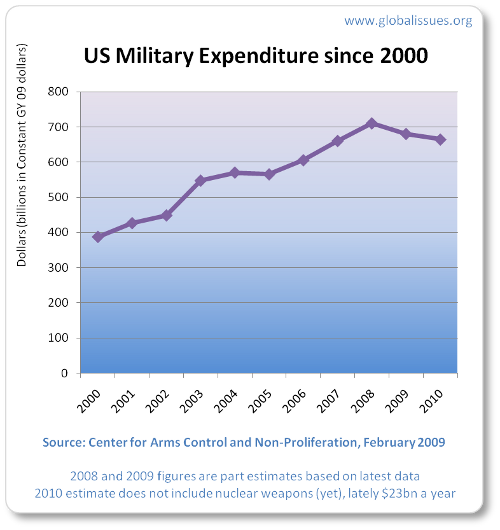
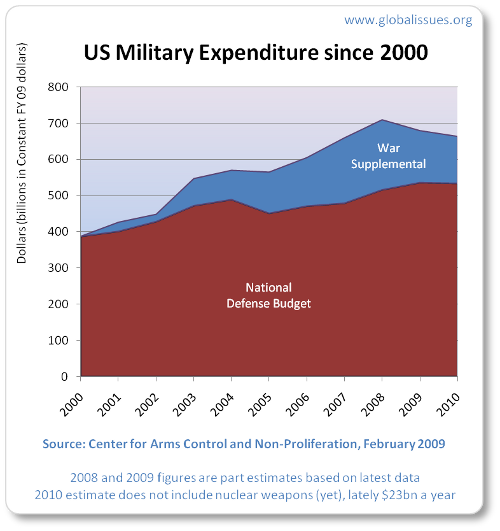
- Between 2000 and 2008, including supplemental war spending, U.S. military spending increased from 387 billion to 710 billion, an 83% increase. (1)
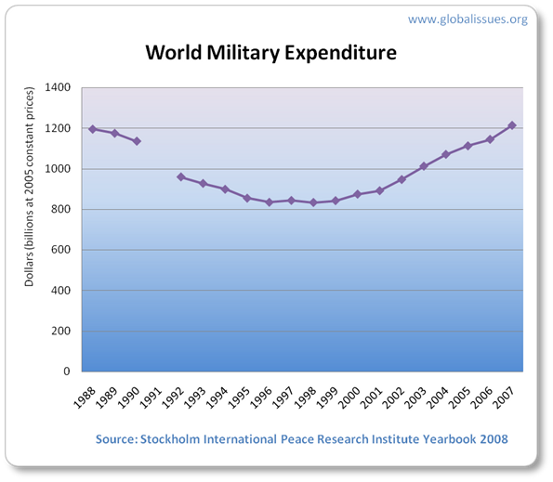
- In 2007, world military expenditure reached $1.339 trillion (2)
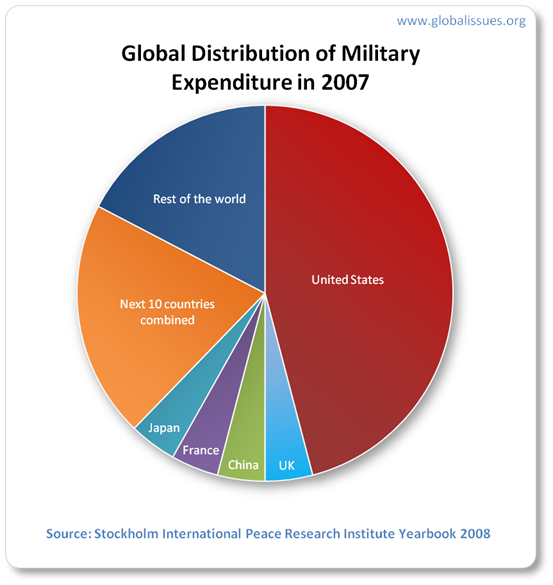
- In 2007, the USA’s military spending accounted for 45 per cent of the world total, followed by the UK, China, France and Japan. (2)
- In 2007, the 15 countries with the highest military spending account for 83 per cent of the total (2)
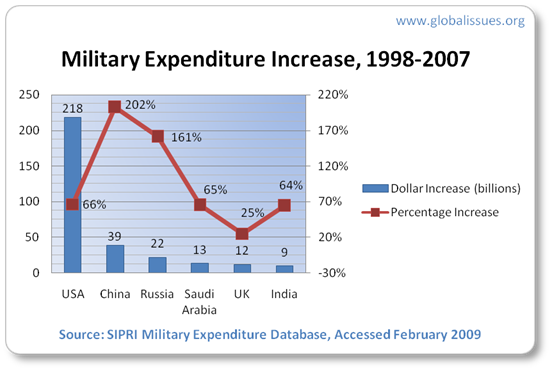
- Between 2001 and 2007 US military expenditure has increased by 59 per cent in real terms, principally because of spending on military operations in Afghanistan and Iraq and due to increases in the ‘base’ defense budget. (2)
- Global Military spending increased 45% between 1998 and 2007 (2)
- In 2007, the United Nations and all its agencies and funds spent $24.9 billion, or about $4 for each of the world’s inhabitants (2)
- In 2007, the UN’s budget was 1.86% of the world’s military expenditure (2, 3)
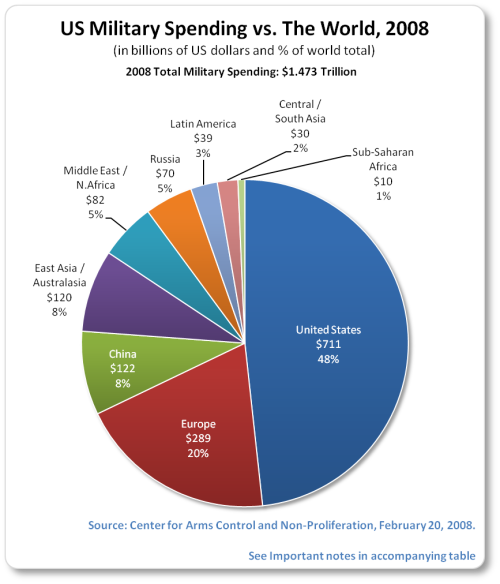
- In 2008, world military expenditure reached 1.472 trillion (4)
- In 2008, U.S. military spending was $711 billion, 48.28% of the global total, followed by China with 8.28%, Russia with 4.75%, and the UK with 3.76% (4)
- In 2008, the combined military spending of the second through eighth largest military spenders (China, Russia, the United Kingdom, France, Japan, Germany, and Italy) was $300.2 million less than the military spending of the first largest military spender, the United States (4)
- In 2008, US military spending was more than the next 46 highest spending countries in the world combined. (4)
- in 2008, US military spending was 5.8 times more than China, 10.2 times more than Russia, and 98.6 times more than Iran. (4)
- In 2008, US military spending is almost 55 times the spending on the six states of Cuba, Iran, Libya, North Korea, Sudan and Syria whose spending amounts to around $13 billion. (4)
- In 2008, the United States and its strongest allies (the NATO countries, Japan, South Korea and Australia) spend $1.1 trillion on their militaries combined, representing 72 percent of the world’s total. (4)
- In 2009, the U.S. Military base budget was $515.4 billion in 2009 plus 135.8 billion in emergency and discretionary spending for a total of $651.2 billion. (5)
- In 2006, including all military-related expenditures outside of the Department of Defense, the United States spent $934 billion on its military in 2006 (6)
- In 2007, one day of spending of the U.S. Pentagon ($1.6 billion) would equal enough funds to ensure antimalarial bed net protection for every sleeping site in Africa for five years (300 million bed nets at $5 each). (7)
- In 2007, the United States spent $572 billion on its military, $11 billion on international security, $14 billion on development and humanitarian aid, and $11 billion for diplomatic functions. (8)
- In 2009, the United States spent $710 billion in military spending (4), $18.8 billion in total bilateral economic assistance via USAID (9), and $5.2 billion in development aid to Africa (10)
- Military expenditure comprised approximately 2.4 per cent of global gross domestic product (GDP) in 2008. (11)
- The combined arms sales of the Top 100 arms-producing companies reached $347 billion, an increase of 11 per cent in nominal terms and 5 per cent in real terms over 2006. (12)
- Between 2002 and 2007 the value of the Top 100 arms sales has increased by 37 per cent in real terms. (12)
- Forty-four US companies accounted for 61 per cent of the Top 100’s arms sales in 2007, while 32 West European companies accounted for 31 per cent of the sales. (12)
- The estimated financial value of the international arms trade in 2007 was $51.1 billion. According to national data, the USA was the largest arms exporter in 2007, with exports worth $12.8 billion; Russia was in second place, with $7.4 billion; France was in third place, with $6.2 billion; Israel was in fourth place, with $4.4 billion; and the UK was in fifth place, with $4.1 billion. (13)
Additional Facts in Graphs & Images:
 |
 |
 |
 |
 |
 |
 |
 |
| Image Source: U.S. Military Spending vs. the World, Center for Arms Control and Non-Proliferation |
 |
 |
 |
| Image source: Stockholm International Peace Research Institute (SIPRI)’s 2009 Year Book, Appendix 2A |
 |
| Image source: Stockholm International Peace Research Institute (SIPRI)’s 2009 Year Book, Appendix 6A |
 |
| Image source: Stockholm International Peace Research Institute (SIPRI)’s 2009 Year Book, Appendix 6A |
 |
| Image source: Stockholm International Peace Research Institute (SIPRI)’s 2009 Year Book, Appendix 6B |
 |
| Image source: Nuclear Warheads by Country, Stockholm International Peace Research Institute (SIPRI)’s 2009 Year Book, Chapter 8 |
 |
| Image source: Nuclear Warheads by Country, Stockholm International Peace Research Institute (SIPRI)’s 2009 Year Book, Appendix 12A |
|
Fact Sources:
|
Please add comments below on any thoughts you have or additional good sources. Thank you!
25 Facts on Global Poverty
August 1, 2009
25 Facts on Global Poverty
August 16, 2009 · Print This Article
One of the challenges I’ve faced as I’ve sought to learn all I can on global poverty over the past few years has been how challenging it is to find accurate, trusted statistics on the topic. I spent a few hours tonight beginning a compilation of stats on global poverty, which I’ve added as a new page on The Humanity Campaign web site.
What do you think about these facts? What can we do to end extreme poverty in our lifetime? Please feel free to comment at the bottom of the page.
Special Thanks:
Thank you to the site GlobalIssues.org for their work in collecting verifiable facts and statistics on major global issues. Their page “Poverty Facts & Stats” was of great help in compiling these statistics. Thank you also to the World Bank, UNICEF, UNICEF Cananda, and UNDP for vital reports neccessary for the compilation of these statistics. The United Nations report “The Millennium Development Goals Report 2009” was also particularly helpful.
A Collection of Sourced & Verifiable Facts on Global Poverty
To make it on this list a statistic must be from a trusted primary source with a clear “as of” date. All statistics are sourced and cited at the bottom of the page.
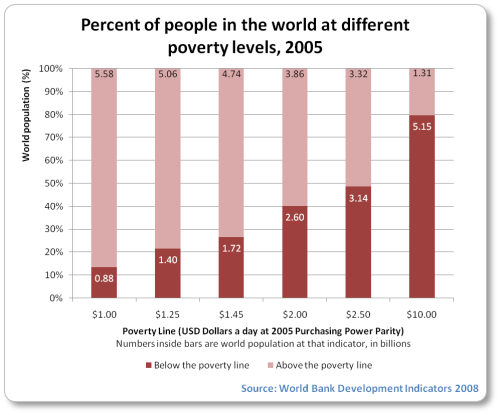
- As of 2008, 79.8% of humanity lives on less than $10 per day. (5.15 billon people) (1)
- As of 2008, 48.6% of humanity lives on less than $2.50 per day. (3.14 billion people) (1)
- As of 2008, 40.2% of humanity lives on less than $2 per day. (2.60 billion people) (1)
- As of 2008, 21.7% of humanity lives on less than $1.25 per day (1.40 billion people) (1)
- As of 2008, 13.6% of humanity lives on less than $1 per day. (880 million people) (1)
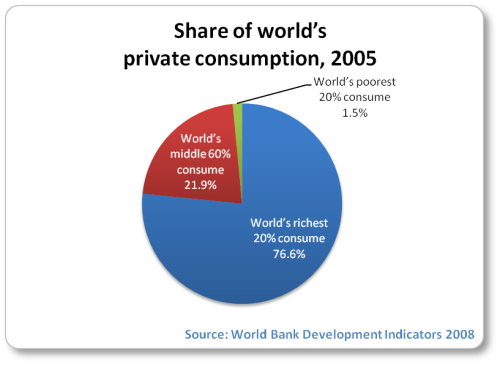
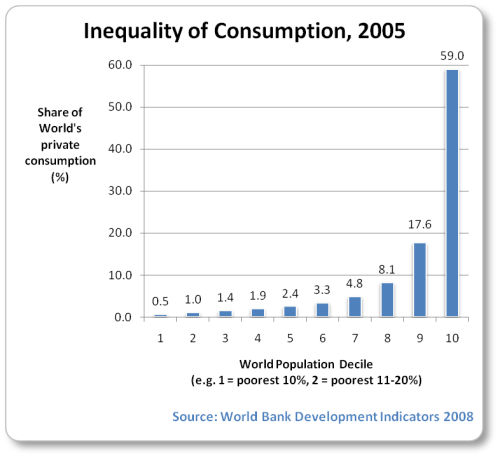
- As of 2008, the world’s richest 20% consume 76.6% of private consumption (1)
- As of 2008, the world’s richest 10% consume 59.9% of private consumption (1)
- As of 2009, 25,000 children under 5 years old die each day due to poverty (2)
- As of 2006, access to piped water into the household averages about 85% for the wealthiest 20% of the population, compared with 25% for the poorest 20%. (3)
- As of 2007, every year there are 350–500 million cases of malaria, with 1 million fatalities: Africa accounts for 90 percent of malarial deaths and African children account for over 80 percent of malaria victims worldwide. (4)
- As of 2007, 1.6 billion people — a quarter of humanity — live without electricity (5)
- As of 2007, the GDP (Gross Domestic Product) of the 41 Heavily Indebted Poor Countries (567 million people) is less than the wealth of the world’s 7 richest people combined. (6, 7, 8 )
- As of 2009, the poverty line in the USA for a single individual is drawn at $10,830 per annum or $29.67 per day. (9)
- As of 2006, 10.6 million children die every year from causes that are easily preventable – equal to 29,000 children every day (10)
- As of 2006, half of these deaths 29,000 daily deaths of children occur in just six countries – China, the Democratic Republic of the Congo, Ethiopia, India, Nigeria and Pakistan (10)
- As of 2006, 2 million children die every year from pneumonia and other acute respiratory infections, making it the leading cause of death of children under five years of age (11)
- As of 2006, 1.6 million children die every year from Diarrhoeal disease, primarily from the resulting severe dehydration that can quickly result in the failure of vital organs in young children (11)
- As of 2006, 1.1 million children die every year in Africa from malaria, making it the largest cause of death for children under five in Africa. (11)
- As of 2006, 657,000 children under the age of 15 are infected with HIV every day, most through transmission of the virus from mother to baby during pregnancy, childbirth or breastfeeding (11)
- As of 2006, 500,000 children die every year from measles. (11)
- As of 2008, on the whole, people are healthier, wealthier, and live longer today than 30 years ago. If children were still dying at 1978 rates, there would have been 16.2 million dealths of children globally in 2006. In fact there were only 9.5 million such deaths. This difference of 6.7 million deaths is equivalent to 18,329 children’s lives being saved every day. (12)
- As of 2007, each year, more than 500,000 women die from treatable or preventable complications of pregnancy and childbirth. (13)
- As of 2007, in sub-Saharan Africa, a woman’s risk of dying from complications from childbirth over the course of her lifetime is 1 in 16, compared to 1 in 3,800 in the developed world. (13)
- As of 2005, an estimated 15.2 million children had lost one or both parents to AIDS (14)
- In 2008, net disbursements of official development assistance (ODA) reached $119.8 billion. That is equivalent to 0.3 per cent of developed countries’ combined national income. (15)
Global Poverty Facts in Graphs
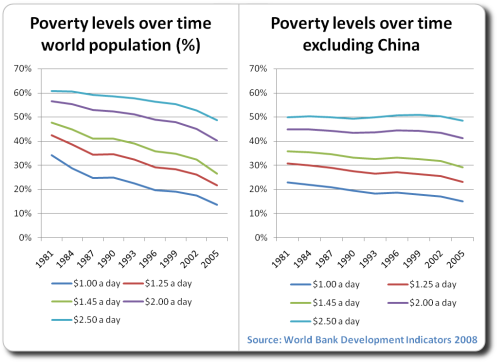


Source: UN Millennium Development Goals Report 2009, p. 51

Source: UN Millennium Development Goals Report 2009, p. 52
Sources:
- World Development Indicators 2008, World Bank, August 2008
- UNICEF State of the World’s Children, 2009
- 2006 United Nations Human Development Report, pp.6, 7, 35
- 2007 Human Development Report (HDR), United Nations Development Program, November 27, 2007, p.25.
- UN Millennium Development Goals Report 2007, p.44
- World Bank Key Development Data & Statistics, World Bank
- Luisa Kroll and Allison Fass, The World’s Richest People, Forbes
- World Bank’s list of Heavily Indebted Poor Countries (41 countries)
- www.hhs.gov“. The 2009 HHS Poverty Guidelines. http://aspe.hhs.gov/poverty/09poverty.shtml.
- UNICEF Canada 50 Year Progress Report 2006, Overview Sheet
- UNICEF Canada 50 Year Progress Report 2006
- World Health Organization, World Health Report 2008, p. 14
- UN Millennium Development Goals Report 2007, p.16
- UN Millennium Development Goals Report 2007, p.20
- UN Millennium Development Goals Report 2009, p. 48
Day One: EO/MIT Entrepreneurial Masters Program
June 23, 2009
I’m in Dedham, Massachusetts tonight (pronounced Dead-um I think) just southwest of Boston.
Tonight, I started Day One of the Class of 2011 EO/MIT Entrepreneurial Masters Program. The program is a four day a year/three year program open primarily to members of Entrepreneurs’ Organization who are founders or co-founders of companies doing at least $1M per year in sales. It is held here at the MIT Endicott House.
Tonight we started with introductions. So far, I’m impressed with the group. I’m particularly impressed with the international diversity of the attendees. Of our sixty four classmates, twenty eight are from outside the United States. We have classmates from 16 countries including the U.S., Canada, Germany, Hong Kong, the United Kingdom, Spain, South Africa, El Salvador, Nicaragua, Guatemala, India, the Netherlands, the Phillippines, Australia, Mexico, and Saudi Arabia.
Going into this evening’s introductory session, I knew only one other attendees, the 26 year-old brilliant phenom Sachin Duggal of Nivio. I met Sachin while in New Delhi in February and have to say he is on the list of the 10 Most Impressive People I’ve Met in the Last 12 Months.
During the introductions, I circled the names of a few folks to ensure I speak further with; Craig Fuller of Transcard, Chris Hanahan on Rotten Gorilla, Itu Kgaboesele of South Africa’s Sphere Holdings, David McMullen of RedPepper, Cam Mochan of The CRUX Company, Francisco Prado of El Salvidor’s d’Anconia Investments, Shashi Reddy of Case-mate, Susan Hrib of Signum Group, Sebastian Ross of Spain’s Grupo Intercom, and Martin Schuurman of the Netherland’s fastest growing company, Inkoopcollectief Yiggers.
I’m also glad to have learned that at least two of the attendees are iContact customers so far.
I’m looking forward to tomorrow. We’ll be hearing from Verne Harnish on the Rockefeller Habits, Patrick Thean on the One Page Strategic Plan, John DeHart on Nurses Next Door, and Geoff Smart on TopGrading.
I look forward to posting tomorrow night about what I learn!
Recent Comments