


A Place of Ideas: Renaissance Weekend Day One
September 1, 2008
I’m in Aspen, Colorado for an inspiring gathering over Labor Day Weekend. It’s Friday night at 10pm and the dance floor is calling–but I am driven to write first and dance later.
The gathering is called Renaissance Weekend, started by Ambassador Phillip Lader and Linda Lader in 1981. I first heard of the Weekend on my way to the Orlando airport in 2006 while serendipitiously sharing a taxi with former U.S. Congressman Martin Lancaster, the current President of the NC Community College System.
We were on our way back from the National Association of Community College Entrepreneurship (NACCE) conference. He told me how the weekend gatherings, originally in Charleston, SC over New Year’s and now in Aspen, Tuscon, and Monterey, brought together driven and accomplished people to discuss public policy, science, business, religion, and more.
I took a look at the site and saw past participants included Bill and Hillary Clinton, Alan Greenspan, Gerald Ford, Evan Bayh, Howard Dean, Bill Richardson, Janet Napolitano, Lawrence Summers, Ted Turner, Steve Case, Steve Jurvetson, Steven Colbert, and North Carolinians Terry Sanford and John Sall.
I wanted to go, but had no way in.
I heard nothing more of this gathering for two years, until this June when my friend Stever Robbins gave me a call. He nominated me to attend and wonderfully I’m now here.
Today was the first full day of Renaissance. I must say from the first day that it has been a wonderful experience so far. One of the ways the Weekends are different than any other conference is that every attendee is assigned to present briefly (for 2 minutes to everyone and then for about 10 minutes in numerous breakout panels) on either what they know most about or what they are most passionate about. This practice enables attendees to hear from experts in their field ranging from astronauts to cosmologists to entrepreneurs to neurosurgeons. At this Weekend, there are about 300 attendees.
Today I was assigned to present for 2 minutes to the group on “An Immodest Proposal – If I Could: Serious and humorous proposals on policy, work, religion, and marriage.” I then participated on a panel with six others called “Why Not Change the World? Examples and Visions of Social Entrepreneurship & Community Service.”
At noon, I experienced the most intellectually stimulating hour of my life since the panel on global peace at Fortune Brainstorm with Jeff Bezos last month. My friend and venture capitalist Nick Beim from Matrix Partners moderated a panel called “Putin’s Czarist Plan: Is His Russion a Neo-KGB State” that I hope to post about next.
Tomorrow, Saturday morning, I’m presenting for 2 minutes at 9am on “When I’m 65 – A Red Bull Generation Envisions Their Professional, Personal, & Nation’s Future,” taking the afternoon off to go white water rafting for the first time in my life on the Colorado River, then returning for a 6pm discussion, “Must There Always Be a Bottom Billion: Promise & Pitfalls of Reducing Poverty, Supporting Social Entrepreneurs, and Assisting the World’s Less Developed Nations.”
As a short aside I’ll share a fun story. This visit is my first time in Aspen and the Aspen Institute since July 2006 for Fortune Brainstorm 2006. I recall then sitting next to John McCain for 10 minutes while watching the Germany-Italy World Cup game in the lobby of Aspen Meadows and then seeing him go to the back of the lounge to speak with Vinod Khosla, ostensibly about alternative energy. Thinking she was a passerby and not knowing then who she was, I asked Cindy McCain to take a picture of Senator McCain and I. She somewhat unwillingly oblidged, but alas, the camara battery was dead and no proof exists.
This is a place of ideas and action–action that leads to making a difference in the world. I’m fortunate to be here and look forward to sharing tomorrow night how the day goes.
“With equally distinguished participants, all Renaissance Weekends foster lively exchanges which transcend ideological, political, economic and religious differences. This eclectic, non-partisan group – CEOs, venture capitalists and entrepreneurs, Nobel Laureates and Pulitzer Prize-winning authors, artists and scientists, admirals, astronauts and Olympic athletes, judges and journalists, volunteers, diplomats and work-at-home parents, Presidents, Prime Ministers, professors and priests, Republicans, Democrats and lots of Independents, innovators from across America and several nations – has become for many an extended family.”
The dance floor is calling my name…
Thoughts on Uganda
July 10, 2008

I was in Uganda from June 29-July 6. I was there to visit two non-profit organizations I have been involved with and contributed funds to in the past. It was my first visit to Africa, and definitely will not be my last.
Uganda really is a beautiful country. It has lots of challenges, yet lots of real opportunities. Seeing the extreme poverty that exists there first hand was difficult, yet instructive and very helpful to my understanding of the issue. 89% of Ugandans are currently subsistence farmers, so a great majority of the population lives in rural villages. It was very common to see families of 6 to 8 living in mud and stick one-room shacks with tin or grass roofs with dried dung floors with no running water, toilet, or electricity. The primary school we visited in Mityana in the West had neither windows nor doors and had dirt floors.
Even more difficult is the realization that the difficulty of the living conditions I saw in the rural areas pale in comparison to those in the refugee camps 300 miles to the north in Northern Uganda, centered around Gulu which was the center for the LRA activity, which has significantly calmed since the 90s. I was amazed at the extent to which the children and most adults living in these most difficult conditions maintain such a level of happiness and non-complaint.
It was a bit unnerving to see out front of every bank and gas station an armed security guard with a rifle or shotgun. The traffic is absolutely insane, enhanced by the pavement ending at times. At one point we were passing a car that was passing another truck, and got driven into the shoulder on the other side of the road. That type of experience was common. There are no medians and the highways are all two lanes. There are just three stop lights in Kampala and none elsewhere in the country.
The thousands of Boda Bodas (motorcycles) and Matatus (bus taxis) all over and the pedestrians crossing allover add to the confusion. And not to mention the cows, which are often in the road calmly walking across. Cows and goats tend to be tied up to the side of the roads so they can be used for mowing. Babies run around naked or just wearing shirts, often with no parents in sight, and kids from 3 to 12 wearing bright purple, yellow, green, or blue school uniforms can be seen walking along the side of the roads for miles around 8am and 5pm each day. The kids would often smile and yell out “Muzungu” which means white person when we drove by.
The current Museveni administration has been in power since 1986 and while it seems to be succeeding in providing some basic services, the roads are still very spotty and the electrical grids shut off a few hours per day outside Kampala. Many are calling for him to leave, not because he’s doing a horrible job but because he’s been in power 22 years. They seem to have a good freedom of speech there and an opposition newspaper. People we spoke to were not shy to offer their criticisms. Many people were speaking about Mugabe and his visit to the African Union last week and hoping for his ouster.
The economy is growing. The competition between CelTel, Warid, Uganda Telecom, and MTN for cell phone was intense. All the services sell Airtime Credits rather than monthly subscriptions since most Ugandans do not have a fixed postal address nor a credit card. These four companies advertise literally everywhere, including painting in exchange for compensation thousands and thousands of buildings and homes along the side of all the roads.
Uganda now has GPRS service which allowed me to access my Blackberry email without a problem most of the time even in very rural areas.
They also are deploying 3G service in the major cities. I saw a number of iPhones there among lawyers and professionals. The biggest employer in Uganda is interestingly Coca Cola. There are tremendous opportunities to invest in alternative energy production, especially in regards to biomass. Roey and I had a chance to visit Torero Cement, the largest cement factory in Uganda on Friday as he’s working with them to supply biomass so they can reduce their coal usage. The economy remains a cash economy. I did not find a single store or company that accepted credit cards outside of the airport.
We stayed with an investment banker who runs Daro Capital on Friday night in Kampala. He help a get together of a group of technology execs and professionals on Tuesday night, including a gentleman who is starting an SMS marketing service. I spoke to a number of people to get a sense of the ripeness for email marketing. Rough statistics, but it seems right now about 25pc of Ugandans have email addresses, though most check them via Internet Cafes. Broadband access is only available via Satellite at a cost of USD$1000 per month, so even the professional class and wealthy have only dial up or GPRS access. A T1 is being installed in Uganda in 2009 after which access will go substantially up.
We visited Entebbe and Kampala on Day 1, Mityana on Day 2, Mbale on Day 3 and 4, and Torrero on Day 5, and Mukono on Day 6. We also drove though Jinja and saw the source of the Nile river.
In Mityana, we visited Nourish International Students working at Naama Millennium School, a school funded by Dr. Christopher Kigongo, who now lives in Durham most of the year and was the former Director of Health Education for Uganda. In Mbale, we visited the Foundation for the Development of Needy Communities (FDNC) which has a vocational school and special needs school founded by Samuel Watulatsu, who presented at a Entrepreneur & Social Entrepreneur Meetup at our house in Chapel Hill last October.
On the way there I spent a day layover in Dubai. Dubai is one of the 7 emirates in the United Arab Emirates, so it’s the size of a county and has 6-7 cities in it, that have names like “Internet City, Media City, and Sports City.” The amount of construction and cranes there was immense. The Emirate boasts an indoor skiing area, and man-made islands in the shape of a palm tree and one in the share of the world. They have built the largest building in the world, the Burj Dubai, shown in picture 4. It is still being finished. When it is done next year it will be 166 floors and 2100 feet tall.
Bottom line, the experience has caused me to be even more dedicated toward spending the rest of my life working to increase access to education, healthcare, food, and technology and working toward ending warfare and ensuring sustainability. I look forward to going back again soon.


This Page May Contain Content That is Not Consisent With the Moral Cultural, or Social Values of the UAE
June 23, 2008

I was in Dubai for a night two weeks ago on my way to Uganda and tried from my Holiday Inn Express in Dubai Internet City home of the Middle East campuses of Sun Microsystems, Cisco, and EMC and to access a blog called Secret Dubai Diary. The site came up in a Google search for Dubai nightlife. When I tried to access the site, I got the lovely “Surf Safely” message above, indicating that this site was “inconsistent with the moral, cultural, or social values of the UAE.” Unfortunately for the government censors in the United Arab Emirates, they didn’t think to block the Google Cache version of the page.
It was very reassuring that UAE recognizes the Internet as a “powerful medium of communication, sharing and serving our daily learning requirements.”
If you wish, you can send an email to “safesurf[at]du.ae” to share your view of Internet censorship.
At Fortune Brainstorm Tech in Half Moon Bay, CA | Dare Mighty Things
May 23, 2008

Today through Wednesday I am the Fortune Brainstorm Tech conference in Half Moon Bay, California, about 45 minutes south of San Francisco. After a Segway tour along the Pacific this afternoon, the sessions began at 4pm. We’ve heard from Michael Dell, Jeff Bezos, Marc Benioff, and Brad Smith, the CEO of Intuit.
Here are some notes on what some of the panelists spoke about:
Dell
- 500,000 people per day who come onto the internet for the first time
large majority are outside the United States - Long term bull on the long term impact technology can have on society
- Came back as CEO for second time
- Put his ‘big ears’ on, listened to the employees
- Thought of themselves as a company that listened
- Will have about 2 billion conversations with our customers this year
- centrally controlled tops-down is not most response way
- We should have fiber to the home
Benioff
- It’s not just company talking with customers, but customers talking with eachother in a one to many conversation
- Customers are able to gang up on us
- The acceleration of the soul of the world
- Fareed Zakaria – Post-american World
- The internet is the great accelerator in societal evolution
- A change in the world can only happen if there is a change in conciousness
- Dalai Llama – world peace comes through inner peace
- web 1.0 – transact
- web 2.0 – collaborate
- web 3.0 – innovate (via platform)
Brad Smith, 5th CEO of Intuit in 25 years
- 50 million end users
- Connecting florists with florists in different zip codes
- Intuit now 50% SaaS
Other livebloggers at the conference include:
- Joi Ito
Chief Executive Officer, Creative Commons - Rebecca MacKinnon
Co-founder, Global Voices
Assistant Professor
University of Hong Kong - Amy Messenger
Managing Director, U.S. Technology Practice Head
Ogilvy Public Relations Worldwide - Chris Elam
Founder and Director
Misnomer Dance Theater - Rodrigo Sepulveda Schulz
Chief Executive Officer, vpod.tv - Aaron Houghton
Co-founder and Chairman, iContact - Frank Shaw
President, Microsoft Accounts, Worldwide
Waggener Edstrom Worldwide - Richard Edelman
President and CEO, Edelman - Ryan Allis
Co-founder and CEO, iContact - Ross Mayfield
Chairman, President, and Co-founder
Socialtext - Thomas Crampton
Director, New Business Development
Next Media - Per Mosseby
Chief Executive Officer, Islanders - Steve Jurvetson
Managing Director
Draper Fisher Jurvetson - Bart Becks
President International and Director
Netlog - Julia Boorstin
CNBC - Oliver Marks
ZDNet - Bruce Carlisle
CEO, Digital Axel - Susan Hassler
Editor in Chief, IEEE Spectrum - Daniel Kaufmann
Director, Governance and Anti-Corruption, World Bank Institute
Project Polaroid: Giving A Child Their First Picture | Dare Mighty Things
May 23, 2008
How do you get the attention of a large global company (Polaroid) and convince them to reverse a key strategic decision? Hopefully, like this…
The Birth of Project Polaroid
Nine months ago, in early January, I was hanging out in Charlotte with a friend of mine named Carly. Carly is just 20 and a junior at UNC-Chapel Hill. She is an entrepreneur and a social entrepreneur who runs a photography business, Carly Brantmeyer Photography. We were brainstorming. She wanted to do more than be a student and photographer. She wanted to use her talents and abilities to give back.
Carly had just returned from a Christmas family trip to Costa Rica. There, she took lots of beautiful digital photos. The children were eager to see the picture she just took of them on the back LCD display. She wanted to be able to give the children a copy of their photo, but couldn’t. There was no easy way.
She thought, “If I had a Polaroid camera with me I could give them a copy of the picture right now.”
She returned and while brainstorming at her house in January she came up with Project Polaroid. She would bring hundreds of Polaroid instant film with her to developing countries and give children a picture of themselves–something most of them would never seen before, yet alone owned.
Project Polaroid in Colombia
Carly had the opportunity to visit Colombia over the summer to try out Project Polaroid for the first time. She borrowed my Polaroid camera that was given to me as a gift in 2007 and bought some film. Here are some of the inspiring pictures she took. Take a look especially of the one of the mother, holding a picture of her beautiful young daughter for likely the first time:


Project Polaroid in Uganda
In July, I went to Uganda for a week. Carly had returned from Colombia so I got my camera back the night before. Here are some of the pictures I took.


I was able to take about 60 pictures there while in Uganda while in 4 different locations. Each time I noticed an interesting phenomenon. In one of the locations, I found myself in a small village near the Mirembe Kawomera Peace Coffee Cooperative. This place was about 30 minutes down a dirt road from Mbale, Uganda. I took my first photo of a child and gave it to her. She was very confused as to what it was. I told her to shake the picture. She then ran away, nervous it seemed.
Exactly, on the dot, 3 minutes later, a group of at least eight kids came running around the corner jumping up and down with excitement. The picture had developed! Each time I began taking photos with just one or two children. They would go away, wondering what I had gave them (most Ugandan children in villages speak little English), then come back with their whole crew just 2-3 minutes later when they realized what had been given to them. This run away, see the photo develop, and bring back more children would happen every time. Sometimes, as Carly has experienced, you get surrounded by as many as 40 or 50 children within minutes.
In the village outside of Mbale I also gave away some of the soccer jerseys and shorts that had been donated by Sports Endeavors of Hillsborough, NC, the owners of Soccer.com and Eurosport, through the U.S. Soccer Foundation Passback Program. The children created such a commotion that the villages lone police office came over hurriedly, thinking the children were stealing from the van.
Project Polaroid in Ghana
This fall semester, Carly is living and studying in Legon, Ghana at the University of Ghana, with a study abroad program from UNC. She has received a number of donations to help expand the program and has brought dozens of packs of film. Here are some of the photos she’s taken so far in Ghana:


Polaroid Will Stop Selling Polaroids in Early 2009
For background information, back in 2001, Polaroid Corporation, the makers of the famous Polaroid Cameras and instant film filed for bankruptcy. It’s assets ended up being purchased by a private investment firm, Petters Group Worldwide, in 2005.
Very unfortunately for Project Polaroid, Polaroid announced back on February 8 that it will be phasing out production of its instant film and that it will be completely off the shelves by early 2009. We were of course a bit saddened by this announcement. Polaroid will no longer sell Polaroids. It’s a travesty of sorts and will certainly make the project difficult to scale. Polaroid has said that it will be willing to license its instant film technology to another firm should another firm be interested. Here’s hoping Polaroid somehow comes across this story and they realize the immense value that Polaroid film has to their brand.
Carly writes on her detailed travel blog.
“The idea is simple. $1=1 Polaroid photo, for 1 kid, that will last a lifetime. So many children around the world have never even owned a single photo of themselves. What could be more precious of a memory than a photo of you/your family?”
How You Can Help
When she left, Carly raised money from her family and community. She was able to take a few dozen packs of film with her. A month into the trip, Carly is now running out of film. If you would like to contribute, the best way would be to mail her a pack of two of Polaroid 600 film. She would very much appreciate any help. She will be at the following address until December:
Carly Brantmeyer
University of Ghana
c/o International Programs Office
International Student Housing II
Room #127
Legon, Accra, Ghana
Update: If you’d prefer you can send them to Charlotte where Carly’s mom Lisa has offered to collect them and mail them in one package to Ghana. The address is: 14803 Davis Trace Drive, Charlotte, NC, 28227.
Overall, I am excited to see Project Polaroid in Ghana and look forward to her getting back in January and brainstorming how to scale the project to many more developing countries. Being in Uganda myself in July and seeing the impact owning a simple picture can have in the life of a child and the parents of that child has made a lasting impact on me. One of the children was 3 and didn’t have pants–just a long shirt. He lived in a thatch hut near a school Roey and I were speaking at with his brother, sister, and mother. He didn’t have pants but he was overjoyed with happiness to have the picture. Hopefully we can convince Polaroid to sponsor the project in the future and keep producing instant film.
What We Did in Berlin Today
April 23, 2008
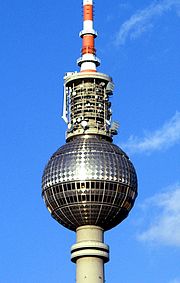
Today in Berlin we met up at 3pm for a walking tour of the city, then ended up at 5pm at the British Council office at Alexanderplatz 1 in East Berlin next to the Fernsehturm television tower that was a major symbol of the GDR in the communist era.
We began at 5:30 with a brilliantly led introduction and ‘The Great Transatlantic Debate.’ We lined up in order of height, grouped into teams of 5, and then separated into planning rooms.
Each of the six teams (we were team 3) had a provided thesis they had to prepare to prove in the upcoming debate. Our team was tasked to prove that ‘the relationship between America and the E.U is strong and getting stronger.’
In our five minutes, Peter Macleod from Canada played the American husband and Angela Brunete from Spain played the European wife. Peter allegorically referred to the EU/US relationship as a marriage in which there were ups and downs but at the end of the day we would always be together. Angela accused Peter of cheating on her with India, and Peter accused Angela of cheating on him with China. But they reconciled as Rabah Ghezali from France shared the cultural and historical ties including the core values of liberal democracies and the Marshall Plan, Dragos Pislaru from Romania shared the strategic and military ties including our recent learnings of what can happen when we don’t truly work together in global conflict, and I shared the economic ties including trade and FDI growth. Team Four proceeded to present the other side of the argument for five minutes, followed by a one minute rebuttal.
Following the debates, we discussed issues including the identity challenge, citizen media, technology and mobility, E.U. enlargement, the relative stasis of the U.S., whether there were 4, 5, or 7 continents in the world (Europeans learn 5), red blue and purple America, the Stockholm consensus, lateral relationships between the U.S. and Eurozone countries, whether the West or East would most define the 21st century, demography, and our shared history.
After the group discussion we held a reception and dinner and followed on with about three hours of networking in the lounge of the British Council’s office. Around 10, Jeff Johnson and I worked to persuade the group to go to ‘Weekend‘ the dance club across the street in the Sharp Aquos building until we found out that GMF was not name of the Sunday night DJ but rather meant that Sunday night was Gay Night–so we headed to Bar Wave at the Novotel instead.
We’re all building some tremendously valuable connections that will help our businesses, non-profits, and public service organizations for many decades to come while broadening our understanding of global challenges and global entrepreneurial opportunites.
I’m off to get back to work on my Sunday night email catchup.
Under 30 CEO Summit This Weekend in Utah
April 23, 2008
I’m out in Alta, Utah this weekend near Salt Lake City for the Under 30 CEO Summit being put on by Elliot Bisnow.
We’ve been skiing at Snowbird, heard from Ted Alemayhu from U.S. Doctors for Africa, chatted with Scott Fredrick from Valhalla Partners, and talked a lot about business, entrepreneurship, social entrepreneurship, and how we can work together to make a difference in the world.
Blake from Tom’s Shoes (which donates 1 pair of shoes to children in developing countries for every pair they sell) debuted his video “No Polo Window” announcing the launch of his leather boots campaign to reduce a foot disease called Podo in Ethiopia. Blake gave us each a pair and I’m quite happy to report they are awesome for breakdancing.
The people that are here include Dan Melinger (Socialight), Cristina Miller (Store Adore),
Sean Belnick (Bizchairs.com), Ben Lerer (Thrillist), Blake Mycoskie (Tom’s Shoes), Cameron Johnson (The Big Give), Ben Kauffman, (Kluster), Josh Abramson (CollegeHumor/BustedTees), Rob Jewell (Gratis Internet), Joel Holland (Footage Firm),
Lin Miao (Tatto Media), Ricky Van Veen (CollegeHumor/BustedTees), Jud Bowman (Motricity), Sam Altman (Loopt), Anthony Adams (CreditCovers), Nathan Stevens (Yodle), and Jeff Fissel (KZO Networks).
Yesterday I skied for the second time and went from extreme beginner to beginner. It’s been a great time so far and I’m looking forward to tonight.
$1M Prize for Best Developing Country Technology Innovation
March 23, 2008
 Legatum Group, founded by Chris Chandler and based in Dubai, has announced today at Fortune Brainstorm Tech in Half Moon Bay, California a $1 million prize for the best technology innovation from a for-profit company in the developing world. I will update this blog when they post details on how to enter.
I wanted to write this post as from all appearances, Legatum seems to be making a concerted effort to invest in long-term sustainable development in developing countries and putting their money where their mouth is. They are a sponsor to the Fortune conference here, and are mostly unheard of. Even their original company Sovereign Global, is nearly unheard of. Yet they manage over $4B in capital invested in India alone.
Legatum is the donor to the Legatum Center for Development and Entrepreneurship at MIT. They invested $50M in the Center to obtain naming rights. Here is a short video I took this afternoon of Iqbal Quadir who is the founder and Director of the Legatum Center for Development and Entrepreneurship at MIT.
Although Dubai-based, the group is made up strictly of Westerners, mainy of whom previously worked at Chris Chandler’s Sovereign Global. They claim a 40% CAGR over the lifetime of thier original fund started in 1986. The President of Legatum, Mark Stoleson, attended Occidental College and Duke. The other chief team members attended Wharton, London Business School, Babdon, Oxford, and University of Brisbane and has worked at law firms, JP Morgan, Goldman Sachs, and PWC.
I do wonder if most of these individuals are based at the head office in Dubai, which is slowly on its way toward challenging London and New York for the global capital headquarters. If you can find any statistics on capital under management for equity investment firms based in New York, London, Hong Kong, and Dubai please let me know.
Legatum Group is also the creators of the Africa Prize, which gave away $450,000 in 2007 to the most innovative businesses in Africa. Their philosophy is simply that for-profit businesses are more efficient at creating positive social improvement than bi-lateral foreign aid which in their Easterlyan-like view too often has created dependency.
How selfish soever man may be supposed…
January 23, 2008

I just sent this to a couple of my friends and wanting to blog it as well. I just watched the video of the much-talked about Gates speech on Creative Capitalism on Friday at Davos. For me, it was one of the most inspiring and influential speeches I have ever heard. Though Gates is not the best speaker in the world, his message is right on. The WSJ article on the speech is here and the video of the speech is here.
I especially enjoyed the Adam Smith quote Gates references:
“How selfish soever man may be supposed, there are evidently some principles in his nature, which interest him in the fortunes of others, and render their happiness necessary to him, though he derives nothing from it, except the pleasure of seeing it.”
Here’s an excerpt from the speech transcript:
In many crucial areas, the world is getting better.
These improvements have been triggered by advances in science, technology, and medicine. They have brought us to a high point in human welfare. We’re really just at the becoming of this technology-driven revolution in what people can do for one another. In the coming decades, we’ll have astonishing new abilities: better software, better diagnosis for illness, better cures, better education, better opportunities and more brilliant minds coming up with ideas that solve tough problems.
This is how I see the world, and it should make one thing clear: I am an optimist.
But I am an impatient optimist. The world is getting better, but it’s not getting better fast enough, and it’s not getting better for everyone.
The great advances in the world have often aggravated the inequities in the world. The least needy see the most improvement, and the most needy get the least — in particular the billion people who live on less than a dollar a day.
There are roughly a billion people in the world who don’t get enough food, who don’t have clean drinking water, who don’t have electricity, the things that we take for granted.
Diseases like malaria that kill over a million people a year get far less attention than drugs to help with baldness.
So, the bottom billion misses the benefits of the global economy, and yet they’ll suffer from the negative effects of economic growth they missed out on. Climate change will have the biggest effect on people who have done the least to cause it.
Why do people benefit in inverse proportion to their need? Well, market incentives make that happen.
In a system of capitalism, as people’s wealth rises, the financial incentive to serve them rises. As their wealth falls, the financial incentive to serve them falls, until it becomes zero. We have to find a way to make the aspects of capitalism that serve wealthier people serve poorer people as well.
The genius of capitalism lies in its ability to make self-interest serve the wider interest. The potential of a big financial return for innovation unleashes a broad set of talented people in pursuit of many different discoveries. This system, driven by self-interest, is responsible for the incredible innovations that have improved so many lives.
But to harness this power so it benefits everyone, we need to refine the system.
As I see it, there are two great forces of human nature: self-interest, and caring for others. Capitalism harnesses self-interest in a helpful and sustainable way, but only on behalf of those who can pay. Government aid and philanthropy channel our caring for those who can’t pay. But to provide rapid improvement for the poor we need a system that draws in innovators and businesses in a far better way than we do today.
Such a system would have a twin mission: making profits and also improving lives of those who don’t fully benefit from today’s market forces. For sustainability we need to use profit incentives wherever we can. At the same time, profits are not always possible when business tries to serve the very poor. In such cases there needs to be another incentive, and that incentive is recognition. Recognition enhances a company’s reputation and appeals to customers; above all, it attracts good people to an organization. As such, recognition triggers a market-based reward for good behavior. In markets where profits are not possible, recognition is a proxy; where profits are possible, recognition is an added incentive.
This week’s Economist had a section on corporate responsibility, and it put the problem very nicely. It said it’s the interaction between a company’s principles and its commercial competence that shape the kind of business it will be.
The challenge here is to design a system where market incentives, including profits and recognition, drive those principles to do more for the poor.
I like to call this idea creative capitalism, an approach where governments, businesses, and nonprofits work together to stretch the reach of market forces so that more people can make a profit, or gain recognition, doing work that eases the world’s inequities.
Some people might object to this kind of market-based social change, arguing that if we combine sentiment with self-interest, we will not expand the reach of the market, but reduce it. Yet Adam Smith, the very father of capitalism and the author of “Wealth of Nations,” who believed strongly in the value of self-interest for society, opened his first book with the following lines:
“How selfish soever man may be supposed, there are evidently some principles in his nature, which interest him in the fortunes of others, and render their happiness necessary to him, though he derives nothing from it, except the pleasure of seeing it.”

Quotes from Day 2 at Altitude
October 23, 2007
Another great day at Altitude. Here are the quotes from the day that Eben highlighted:
“Opportunities multiply as they are seized.” – Sun Tzu
“Next to knowing when to seize an opportunity, the most important thing in life is to know when to forego an opportunity.” – Benjamin Disraeli
“The essence of genious is to know what to overlook.” – William James
“It is better to be first than it is to be better.” – Al Ries and Jack Trout
“As I grow older, I pay less attention to what men say. I watch what they do.” – Andrew Carnegie
“Data is most valuable at the point of origin. The value of data is directly related to its timeliness.” – Lawrence Miller
“When you have mastered the numbers you will in fact no longer be reading numbers, any more than you read words when reading books. You will be reading meanings.” – Harold Greene
I actually got more work done today than I do in a normal day in the office with 88 emails sent and a number of key projects worked on.
Recent Comments