


Tom Friedman: Why We Need a Green Revolution, And How It Can Renew America
May 23, 2008
What is next after the Information Technology (IT) revolution of the last 30 years?
Well, according to Thomas Friedman, it’s the Energy Technology (ET) revolution.
Last Monday I had the chance to hear Mr. Friedman give an impassioned presentation at Duke’s Terry Sanford Institute for Public Policy. I made the following notes from Tom’s presentation about his new book, Hot, Flat, and Crowded. All of the below viewpoints are not necessarily mine, but I do very much share his stated urgency for encouraging investment in energy technology.
======
The Emperor Has Lost Her Groove
Hot, Flat, and Crowded masquerades as a book about energy and the environment. In reality, it’s a book about American losing its way, losing its groove. American has lost her groove over the past 15 years due to:
- Our reaction after 9/11–going into the Iraq War
- The loss of a superpower competitor in the USSR
- Our government not operating efficiently since Bush was elected
We have become the United States of Fighting Terrorism instead of the The United States of America. Our day should be July 4th not September 11th. The government in Washington D.C. simply has been unable to solve long-term multigenerational problems any longer. The U.S. is as innovative as ever, but the government is not maximizing this opportunity.
Energy Technology will have 10x the impact Information Technology had. We need a common vision. What ‘red’ was as a coordinating force in 1950, ‘green’ must be 2008. But instead of going from red to green we’ve gone from red to code red–to a politics of fear.
Meaning of the Title
The significance of the title is:
- HOT – Global warming, the climate system is sensitive. There is only 6 degrees celsius between the ice age and today.
- FLAT – The rise of the middle class all over the world
- CROWDED – Population growth. 2.6B people in 1953 when Friedman was born. 9.2B people in 2053 when he reaches 100 years old. Fuels that we are using today are expensive, exhaustible, and toxic.
The 5 Megaproblems Our World Has:
Key to the book are the five megaproblems our world has. They are:
- Energy and Natural Resources Running Out
- Petrodictatorship
- Climate Change
- Energy Poverty
- Biodiversity Loss
1. Energy & Natural Resources Running Out When flat meets crowded, in an unsustainable world, watch out! There are skyscrapers blossoming from the desert floor in Doha, Qatar. In the 4 years since he was last there, Doha has sprouted a Manhattan. In another city you haven’t heard of, Dalian, China, they’ve also sprouted a Manhattan. That clean air initiative in Vermont was just wiped out by unsustainable growth in a place you probably haven’t heard of.
2. Petrodictatorship
This is the concept of oil revenues leading to great power for semi-elected or unelected leaders/dictators, leading to worse relations with the United States. As price of oil goes up, freedom for oil producing countries goes down. When oil was at it’s de minimus point in 1995 at $16 per barrel, the index of freedom was at its highest in countries like Nigeria, Venezuela, Russia, and Iran. As oil prices have gone up, freedom has declined.

3. Climate Change
The weather will get weirder. The droughts will get longer. The hurricanes will get bigger. There is so much CO2 being released into the atmosphere, we don’t know any more what is an act of God and what is an act of man. Did ‘we’ make Katrina or did ‘He’ make Katrina?
Al Gore should apologize to the world. He should apologize that he underestimated the problem of climate change. Due to China growing faster than initially projected, the original estimates from five years ago were too low. There’s one good thing about healthcare getting better over time–All the climate change deniers are going to live long enough to find out how wrong they were.
4. Energy Poverty
25% of the world is not yet on the electric grid. In China, every 2 weeks generates as much new electricity as sub-Saharan Africa in 1 year, excluding South Africa. Without energy you will fall behind as a society exponentially–in education, healthcare, technology. To be energy poor will be problematic–for us and for ‘them.’
5. Biodiversity Loss
We are the first generation of humans who are having to think like Noah–having to think about saving the last two pair of every species. We are losing thousands and thousands of species that will inhibit our ability to find new medicines.
Problems or Opportunities?
There are two ways to look at this list. Either they are A) Insoluble Problems or B) Incredible Opportunities.
The solution is simple: Abundant, Clean, Cheap, Reliable Electrons. The country that comes up with abundant, clean, cheap, reliable electrons will have the most global respect and the most financial success. America can be this country. We have to rethink green. We are positioned to lead this revolution. Green is the new Red, White, and Blue. Green is the new Patriotism.
The Green Revolution or The Green Party?
Some say we’re in a green revolution already. But no, we’re just having a green party. There’s never been a revolution without someone getting hurt. You’ll know the revolution is here when someone gets hurt. Not physically–but financially. Just like NCR and DataGeneral died when they did not evolve in the IT Revolution and ended up in the Great IT Heaven In The Sky. The world is flat, so change or die, adapt or die.
This is not yet a revolution. It’s a green party. I know–I’m invited to them all.
This revolution will not be easy. It will be the greatest industrial project mankind has ever undergone.
How Do We Stimulate the Revolution Before It is Too Late?
How do we go about finding solutions? We have to innovate our way out of the problem–through the American Marketplace, U.S. universities, and venture capital. We have to find the next ‘Green Google’ and ‘Green Microsoft.’
We need government stimulus however, and here’s why. In the IT Revolution, it was a greenfield opportunity. There were no microcomputers previously. There was no Internet previously. There was nothing to replace. In the ET revolution, there’s existing competition, existing competition from dirty fuels that today are slightly cheaper in the short term, but much more expensive in the long term.
In order to stimulate the start of the ET revolution the Government must force us to take into account the true full cost of dirty fuel. If we do this, we will reach the China Price–the price at which ET will scale in India and China. We need to pay the ‘fully burdened’ cost of the lights. Only the government can do this. This policy will drive immense investment in clean ET and ET will go down the price/volume curve and soon enough become cheaper than we currently pay today.
By putting in a price floor for a barrel oil, for example at $100, firms and investors will be able to make investments in ET without concern that the price will drop and in the short-term they’ll be uncompetitive and die.
By following the policy, the amount the consumer pays over the non-fully burdened cost (if it is less than $100/barrel) would go to the government in the short-term to allow them to invest in ET. This is much better than what happens currently, where the excess goes to petrodictatorships that often work against America’s interests.
Green Revolution Great for American Economy
With higher clean standards, government encouragement, and insurance that the fully burdened price will be charged, the price signals for ET will be right and investment will boom. There is only one thing more powerful than Mother Nature, and that is Father Profit.
As an example, Erie, PA has a export surplus. How does Erie, PA have an export surplus? They have a plan for GE that produces a hybrid locomotive called the EVO. It is in very high demand become it is very efficient with energy. ET is good for the American economy and our trade balance.
We must increase clean standards to force innovations. Standards and price signals matter. If we don’t have a floor under the price of oil, we can’t make investments in ET. In order to launch the Green Revolution and scale, we must do this.
Not About The Whales Anymore
All great change in history was made by optimists. The future is choice, not fate. When you put people together you put the planet together. This is not about the whales anymore. It’s about us. We are all sailing on the Mayflower again.
We must redefine green and rediscover America. $5B in VC went into ET in 2007. But $80B in VC went into IT in 2000. $5B is nothing. We need a game changer. We need standards and a fully-burdened price floor. Then investment will take off.
There’s Now Only One Green Candidate in the U.S. Election
We need the next U.S. President to be a real CEO–a Chief Energy Officer.
As President you have a big bully pulpit. We need him to use it to promote ET. This is the future for America.
I won’t say who I support for President, but let’s just say my wife supports Obama and I love my wife. There’s a guy with 13 cars and a guy with a Ford Escape Hybrid. There’s only one green candidate in this election. We had two, but McCain has changed for the worse under the influence of Drill Baby Drill. Don’t be fooled by windmills in advertisements.
We need to find abundant, cheap, clean, reliable electrons. We need to create green collar jobs–the new blue collar jobs.
How could some people be chanting, “Drill, Baby, Drill.” It’s just stupid. It’s like on the eve of the IT revolution in 1978 someone was chanting “Carbon Paper, Baby, Carbon Paper.” Our motto should be “Invent, Baby, Invent.”
How to Be a Credible Energy Activist
Utilities today are paid based on how much they use. They should be paid on how much they help you save. We need to rewrite the rules for utilities like California and Idaho have.
If you want to be an energy activist, learn what the rules are and how to change the rules. Don’t just protest.
Isn’t it BRICs Turn To Be Dirty?
Brazil, Russia, India, and China might have an argument that we’ve developed dirty for 150 years and now its their turn. I was in China speaking at a conference of auto-industry executives. I said to them, “Sure you can be dirty for the next 20 years if you want. That might save you some money. In the mean time, America’s innovation engine will revolution the world with clean electric cars that cost less and don’t require costly fuel and by the time you wake up we will eat your lunch economically. Sure, go ahead and be dirty.”
China is hiding behind us. If we move, they move.
An Earth Race
We had a Space Race. Now we need an Earth Race. An Earth Race so that man and woman can live sustainably. Without it, we’re dead.
=======
What Do You Think?
What are your thoughts? Is Friedman right? Does he overestimate the problem or is he right on? What do you think about the oil price floor? Please feel free to comment below.

Project Polaroid: Giving A Child Their First Picture | Dare Mighty Things
May 23, 2008
How do you get the attention of a large global company (Polaroid) and convince them to reverse a key strategic decision? Hopefully, like this…
The Birth of Project Polaroid
Nine months ago, in early January, I was hanging out in Charlotte with a friend of mine named Carly. Carly is just 20 and a junior at UNC-Chapel Hill. She is an entrepreneur and a social entrepreneur who runs a photography business, Carly Brantmeyer Photography. We were brainstorming. She wanted to do more than be a student and photographer. She wanted to use her talents and abilities to give back.
Carly had just returned from a Christmas family trip to Costa Rica. There, she took lots of beautiful digital photos. The children were eager to see the picture she just took of them on the back LCD display. She wanted to be able to give the children a copy of their photo, but couldn’t. There was no easy way.
She thought, “If I had a Polaroid camera with me I could give them a copy of the picture right now.”
She returned and while brainstorming at her house in January she came up with Project Polaroid. She would bring hundreds of Polaroid instant film with her to developing countries and give children a picture of themselves–something most of them would never seen before, yet alone owned.
Project Polaroid in Colombia
Carly had the opportunity to visit Colombia over the summer to try out Project Polaroid for the first time. She borrowed my Polaroid camera that was given to me as a gift in 2007 and bought some film. Here are some of the inspiring pictures she took. Take a look especially of the one of the mother, holding a picture of her beautiful young daughter for likely the first time:


Project Polaroid in Uganda
In July, I went to Uganda for a week. Carly had returned from Colombia so I got my camera back the night before. Here are some of the pictures I took.


I was able to take about 60 pictures there while in Uganda while in 4 different locations. Each time I noticed an interesting phenomenon. In one of the locations, I found myself in a small village near the Mirembe Kawomera Peace Coffee Cooperative. This place was about 30 minutes down a dirt road from Mbale, Uganda. I took my first photo of a child and gave it to her. She was very confused as to what it was. I told her to shake the picture. She then ran away, nervous it seemed.
Exactly, on the dot, 3 minutes later, a group of at least eight kids came running around the corner jumping up and down with excitement. The picture had developed! Each time I began taking photos with just one or two children. They would go away, wondering what I had gave them (most Ugandan children in villages speak little English), then come back with their whole crew just 2-3 minutes later when they realized what had been given to them. This run away, see the photo develop, and bring back more children would happen every time. Sometimes, as Carly has experienced, you get surrounded by as many as 40 or 50 children within minutes.
In the village outside of Mbale I also gave away some of the soccer jerseys and shorts that had been donated by Sports Endeavors of Hillsborough, NC, the owners of Soccer.com and Eurosport, through the U.S. Soccer Foundation Passback Program. The children created such a commotion that the villages lone police office came over hurriedly, thinking the children were stealing from the van.
Project Polaroid in Ghana
This fall semester, Carly is living and studying in Legon, Ghana at the University of Ghana, with a study abroad program from UNC. She has received a number of donations to help expand the program and has brought dozens of packs of film. Here are some of the photos she’s taken so far in Ghana:


Polaroid Will Stop Selling Polaroids in Early 2009
For background information, back in 2001, Polaroid Corporation, the makers of the famous Polaroid Cameras and instant film filed for bankruptcy. It’s assets ended up being purchased by a private investment firm, Petters Group Worldwide, in 2005.
Very unfortunately for Project Polaroid, Polaroid announced back on February 8 that it will be phasing out production of its instant film and that it will be completely off the shelves by early 2009. We were of course a bit saddened by this announcement. Polaroid will no longer sell Polaroids. It’s a travesty of sorts and will certainly make the project difficult to scale. Polaroid has said that it will be willing to license its instant film technology to another firm should another firm be interested. Here’s hoping Polaroid somehow comes across this story and they realize the immense value that Polaroid film has to their brand.
Carly writes on her detailed travel blog.
“The idea is simple. $1=1 Polaroid photo, for 1 kid, that will last a lifetime. So many children around the world have never even owned a single photo of themselves. What could be more precious of a memory than a photo of you/your family?”
How You Can Help
When she left, Carly raised money from her family and community. She was able to take a few dozen packs of film with her. A month into the trip, Carly is now running out of film. If you would like to contribute, the best way would be to mail her a pack of two of Polaroid 600 film. She would very much appreciate any help. She will be at the following address until December:
Carly Brantmeyer
University of Ghana
c/o International Programs Office
International Student Housing II
Room #127
Legon, Accra, Ghana
Update: If you’d prefer you can send them to Charlotte where Carly’s mom Lisa has offered to collect them and mail them in one package to Ghana. The address is: 14803 Davis Trace Drive, Charlotte, NC, 28227.
Overall, I am excited to see Project Polaroid in Ghana and look forward to her getting back in January and brainstorming how to scale the project to many more developing countries. Being in Uganda myself in July and seeing the impact owning a simple picture can have in the life of a child and the parents of that child has made a lasting impact on me. One of the children was 3 and didn’t have pants–just a long shirt. He lived in a thatch hut near a school Roey and I were speaking at with his brother, sister, and mother. He didn’t have pants but he was overjoyed with happiness to have the picture. Hopefully we can convince Polaroid to sponsor the project in the future and keep producing instant film.
What We Did in Berlin Today
April 23, 2008
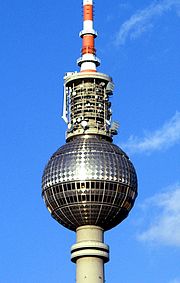
Today in Berlin we met up at 3pm for a walking tour of the city, then ended up at 5pm at the British Council office at Alexanderplatz 1 in East Berlin next to the Fernsehturm television tower that was a major symbol of the GDR in the communist era.
We began at 5:30 with a brilliantly led introduction and ‘The Great Transatlantic Debate.’ We lined up in order of height, grouped into teams of 5, and then separated into planning rooms.
Each of the six teams (we were team 3) had a provided thesis they had to prepare to prove in the upcoming debate. Our team was tasked to prove that ‘the relationship between America and the E.U is strong and getting stronger.’
In our five minutes, Peter Macleod from Canada played the American husband and Angela Brunete from Spain played the European wife. Peter allegorically referred to the EU/US relationship as a marriage in which there were ups and downs but at the end of the day we would always be together. Angela accused Peter of cheating on her with India, and Peter accused Angela of cheating on him with China. But they reconciled as Rabah Ghezali from France shared the cultural and historical ties including the core values of liberal democracies and the Marshall Plan, Dragos Pislaru from Romania shared the strategic and military ties including our recent learnings of what can happen when we don’t truly work together in global conflict, and I shared the economic ties including trade and FDI growth. Team Four proceeded to present the other side of the argument for five minutes, followed by a one minute rebuttal.
Following the debates, we discussed issues including the identity challenge, citizen media, technology and mobility, E.U. enlargement, the relative stasis of the U.S., whether there were 4, 5, or 7 continents in the world (Europeans learn 5), red blue and purple America, the Stockholm consensus, lateral relationships between the U.S. and Eurozone countries, whether the West or East would most define the 21st century, demography, and our shared history.
After the group discussion we held a reception and dinner and followed on with about three hours of networking in the lounge of the British Council’s office. Around 10, Jeff Johnson and I worked to persuade the group to go to ‘Weekend‘ the dance club across the street in the Sharp Aquos building until we found out that GMF was not name of the Sunday night DJ but rather meant that Sunday night was Gay Night–so we headed to Bar Wave at the Novotel instead.
We’re all building some tremendously valuable connections that will help our businesses, non-profits, and public service organizations for many decades to come while broadening our understanding of global challenges and global entrepreneurial opportunites.
I’m off to get back to work on my Sunday night email catchup.
Under 30 CEO Summit This Weekend in Utah
April 23, 2008
I’m out in Alta, Utah this weekend near Salt Lake City for the Under 30 CEO Summit being put on by Elliot Bisnow.
We’ve been skiing at Snowbird, heard from Ted Alemayhu from U.S. Doctors for Africa, chatted with Scott Fredrick from Valhalla Partners, and talked a lot about business, entrepreneurship, social entrepreneurship, and how we can work together to make a difference in the world.
Blake from Tom’s Shoes (which donates 1 pair of shoes to children in developing countries for every pair they sell) debuted his video “No Polo Window” announcing the launch of his leather boots campaign to reduce a foot disease called Podo in Ethiopia. Blake gave us each a pair and I’m quite happy to report they are awesome for breakdancing.
The people that are here include Dan Melinger (Socialight), Cristina Miller (Store Adore),
Sean Belnick (Bizchairs.com), Ben Lerer (Thrillist), Blake Mycoskie (Tom’s Shoes), Cameron Johnson (The Big Give), Ben Kauffman, (Kluster), Josh Abramson (CollegeHumor/BustedTees), Rob Jewell (Gratis Internet), Joel Holland (Footage Firm),
Lin Miao (Tatto Media), Ricky Van Veen (CollegeHumor/BustedTees), Jud Bowman (Motricity), Sam Altman (Loopt), Anthony Adams (CreditCovers), Nathan Stevens (Yodle), and Jeff Fissel (KZO Networks).
Yesterday I skied for the second time and went from extreme beginner to beginner. It’s been a great time so far and I’m looking forward to tonight.
Podcast Interviews on Entrepreneurship
April 15, 2008
Here are two recent podcast interviews on entrepreneurship done by Written Voices and Daxle. Enjoy!
Written Voices Podcast Interview With Ryan Allis (17min 38 sec) – A discussion with Allan Hunkin from Written Voices about:
- Building a team
- My personal motivation
- The importance of finding mentors
- An overview of Zero to One Million including opportunity evaluation, raising capital, marketing and creating sales, giving back, and setting goals
- Finding your core motivation
- Focusing on providing a great product
- Social responsibility
- The Entitlement Generation vs. The Enlightenment Generation
- The Enlightened Entrepreneur
- Finding Your BHALG – Your Big Hairy Audacious Lifetime Goal
Daxle Interview with Ryan Allis (17 min 02 sec) – A discussion with Brian Oates from Daxle about:
- The entrepreneurial itch
- Finding a partner
- Evaluating entrepreneurial opportunities
- Ensuring demand for your business idea
- The value of teamwork
- How internet sales are different from door-to-door sales
- Generating leads from the web
- Bootstrapping and doing what it takes to keep expenses low
Two More Interviews on Entrepreneurship
March 23, 2008
Here are two more recent podcast/radio interviews on entrepreneurship done by Dr. Alvin Jones and Start-Up Spark. Enjoy!
Dr. Alvin Jones Radio Interview with Ryan Allis – (9min 17sec, WMA file) – A March 26, 2008 radio interview on WCBQ-AM 1340 and WHNC-AM 890 with Dr. Alvin Jones from the Paradise Radio Network about:
- Starting in business
- Going to UNC
- Being the son of a priest
- What iContact does
- The quote about taking action by Scottish Mountaineer W.H. Murray
- Setting big goals
- Understanding the entrepreneurial system
- Evaluating business ideas
- The three questions to ask prospective buyers
- Accessing the world of equity capital
Start-up Spark Interview with Ryan Allis (17 min 38 sec) – A discussion with Shannon Cherry from Start-up Spark about:
- Growing up in Florida
- Advantages/disadvantages of young entrepreneurs
- The MAR system
- Bootstrapping and living in the office
- Doing whatever it takes to keep expenses low
- How we hired our first employee
- Using equity initially to reduce cash burn
- The importance of systems and building a team when scaling
- How to avoid creating a job for yourself
- Why hiring people smarter than you is critical
- The definition of an entrepreneur
- Figuring out the purpose of your life
- What will motivate you to get through the hard times
- The mission of The Humanity Campaign
$1M Prize for Best Developing Country Technology Innovation
March 23, 2008
 Legatum Group, founded by Chris Chandler and based in Dubai, has announced today at Fortune Brainstorm Tech in Half Moon Bay, California a $1 million prize for the best technology innovation from a for-profit company in the developing world. I will update this blog when they post details on how to enter.
I wanted to write this post as from all appearances, Legatum seems to be making a concerted effort to invest in long-term sustainable development in developing countries and putting their money where their mouth is. They are a sponsor to the Fortune conference here, and are mostly unheard of. Even their original company Sovereign Global, is nearly unheard of. Yet they manage over $4B in capital invested in India alone.
Legatum is the donor to the Legatum Center for Development and Entrepreneurship at MIT. They invested $50M in the Center to obtain naming rights. Here is a short video I took this afternoon of Iqbal Quadir who is the founder and Director of the Legatum Center for Development and Entrepreneurship at MIT.
Although Dubai-based, the group is made up strictly of Westerners, mainy of whom previously worked at Chris Chandler’s Sovereign Global. They claim a 40% CAGR over the lifetime of thier original fund started in 1986. The President of Legatum, Mark Stoleson, attended Occidental College and Duke. The other chief team members attended Wharton, London Business School, Babdon, Oxford, and University of Brisbane and has worked at law firms, JP Morgan, Goldman Sachs, and PWC.
I do wonder if most of these individuals are based at the head office in Dubai, which is slowly on its way toward challenging London and New York for the global capital headquarters. If you can find any statistics on capital under management for equity investment firms based in New York, London, Hong Kong, and Dubai please let me know.
Legatum Group is also the creators of the Africa Prize, which gave away $450,000 in 2007 to the most innovative businesses in Africa. Their philosophy is simply that for-profit businesses are more efficient at creating positive social improvement than bi-lateral foreign aid which in their Easterlyan-like view too often has created dependency.
Giving Back As an Enlightened Entrepreneur
February 23, 2008
Giving Back As an Enlightened Entrepreneur – Book Excerpt
October 14, 2007 · Print This Article
Below is an excerpt on Giving Back from the updated version of Zero to One Million, coming out in February through McGraw Hill…
Giving Back
I did an exercise when I was 20 years old that changed my life forever. I wrote down how I wanted to use my life to make a difference in the world—to help build stronger communities and societies here at home, and also work to end poverty and hunger globally. When I learned from reading an annual world health report from the World Health Organization that over 18,000,000 people die every year (49,365 per day) from preventable diseases and starvation the gravity of some of the most important issues of our day hit me.
When I learned from a World Bank report that as of 2001, 2.7 billion people lived on under $2 per day (42% of the humans in the world), the realization made me want to spend my life working entrepreneurially to address these issues. When I read The End of Poverty, by Columbia Economist Jeffrey Sachs in 2006, I further committed to being a leader of my generation to address the problems and ensuring that by the end of my life at least 95% of the wealth I create goes back to creating societies with greater access to opportunity and sustainably assisting people who have not had the opportunity I have been so fortunate to have.
As I added to my knowledge through travel, reading, and speaking with people who live in developing nations, I updated my mission statement and began to write what I call a Purpose Statement. Along the way, the added depth of purpose has given what I strive to do every day deep personal meaning. For me, entrepreneurship is not about making lots of money and living an extravagant life, it’s about being able to make a positive impact in the lives of thousands, and hopefully someday, billions. If you can find how starting and building a successful business can help you have a larger meaning in your life and allow you to give back to your community, you will be able to more easily find your core motivation and align what you do, with what you love.
Finding a deeper meaning and core motivation for doing what you do is a critically important part of getting through the difficult times along the way to becoming a successful businessperson. I have found this meaning for myself. As I wrote in the introduction to this book my Purpose Statement is:
I wish to spend my life working through entrepreneurship, social entrepreneurship, investing, philanthropy, public policy, and politics to end poverty in developing nations and at home, ensure environmental sustainability, help people understand that we are one humanity and that our commonalities are much greater than our differences, and help expand access to opportunity, healthcare, and education across the world for every human of every nation.
Right now, please take a moment to write down how you hope to use your talents, resources, and time on this planet to make a positive difference in the world. This can be a powerful exercise, so please take a couple minutes to complete it.
|
Action Item 11 – Finding Deeper Purpose in Your Life |
|
Take a moment and write how you hope to use your business, time, energy, and resources to make a positive difference in the world.
I wish to spend my life… ______________________________________________________ ______________________________________________________ ______________________________________________________ ______________________________________________________ ______________________________________________________ ______________________________________________________ ______________________________________________________ ______________________________________________________ ______________________________________________________ ______________________________________________________ ______________________________________________________ |
Many extremely successful industrialists and entrepreneurs over the past 150 years have chosen to give back. Andrew Carnegie funded libraries all over the United States and created his foundation to ‘promote the advancement and diffusion of knowledge and understanding.’ Rockefeller created the Rockefeller foundation to ‘promote the well-being of mankind throughout the world.’ Ford created the Ford Foundation to ‘promote democracy, reduce poverty, promote international understanding, and advance human achievement.’ Bill Gates has created the Bill and Melinda Gates Foundation to ‘enhance global healthcare and reduce global poverty and expand access to educational opportunity and technology.’ Gates has said many times that he will give 95% of his wealth back to society before he dies. He considers himself a steward of wealth, as should any successful entrepreneur.
As an entrepreneur, score is kept by who can create the most value. Money comes to you directly in proportion to how much value you create by rearranging the resources of land, labor, capital, and entrepreneurial ability into the outputs that society desires. If we are successful, we can create millions, perhaps billions of dollars of value to society and in turn become wealth through stock appreciation, going public, or selling the company.
I hope you will give back as well what you can, along the way as you build your company—and especially after you have become wealthy. It is our job as enlightened entrepreneurs to give back to the society and world that has enabled us to succeed, to work to create fuller access to opportunity. Giving back can make our lives full of meaning and purpose, and make us more driven entrepreneurs at the same time.
I know if you set your mind to it you will become an extremely wealthy individual and make millions of dollars in your life. You may not see the way now, but if you commit to the goal and believe it, you will achieve it in time. It may take ten or twenty years, but if you choose to be, you will become a multi-millionaire. Knowing that you will become a multi-millionaire someday if you make the choice to be, I ask right now that you commit to contributing at least 90% of any wealth you make by the end of your life into a foundation or endowment of a charitable organization that can work to make our world a better place.
|
Action Item 12 – The Enlightened Entrepreneur’s Commitment |
|
I, _______________ _________________ commit to contributing at least ninety percent of any wealth I earn during my lifetime into a personal foundation or endowments of charitable organizations that will work to address the major issues of our world such as poverty, hunger, education, healthcare, environmental sustainability and any other area that I believe will make the world, my nation, my state, and my community a better place.
X __________________________________ Date: ____________ |
Now #2 on Amazon! | Dare Mighty Things
February 6, 2008
Zero to One Million reached #2 on Amazon around 5am this morning and is still there as of 1:30pm! We’re still pushing to get to #1. I’m up against Oprah-backed Eckhart Tolle. That guy is amazing! My only hope may be to get on Oprah!
Check it out at http://www.amazon.com/gp/bestsellers/books
My plane got re-routed and I’m sitting here in the Detroit airport working on getting back to RDU. Boarding now!

What We Accomplished Today — #3 overall on Amazon
February 5, 2008
Blog Readers—
Thank you from the bottom of my heart for your support of the launch effort today of Zero to One Million!
We reached #1 in Business & Investing, #1 in Marketing, #1 in Entrepreneurship, #1 Mover & Shaker, #2 in Non-Fiction, and #3 overall on Amazon today, only bested by Oprah-backed Eckhart Tolle and the perennial favorite John Grisham. We beat out Eat Pray Love, Good to Great, The Tipping Point, Blue Ocean Strategy, Ready, Fire, Aim, The Four Hour Workweek, Secrets of the Millionaire Mind, Getting Things Done, The E-Myth Revisited, and well, every other book in the world other than Tolle’s A New Earth and Grisham’s The Appeal.
The momentum we built today will spread a message of entrepreneurial possibility to tens of thousands of aspiring entrepreneurs across the United States and the world for many months to come. You’ve also helped with the beginnings of a lifetime effort to reduce poverty and hunger by increasing access to health care, education, technology, and entrepreneurial opportunity through The Humanity Campaign.
It’s been an amazing day in so many ways. It is truly amazing what can be accomplished through word of mouth in the name of changing the world and spreading a message of entrepreneurial opportunity.
I wanted to publicly thank Carlos Garcia, Buck Rizvi, Shawn Casey, Tom Bell, Cindy Turrieta, Nana Gilbert-Baffoe, Keith Baxter, Derek Gehl, Dearl Miller, Matt Gill, Michael Simmons, Mark Shay, Rich Sloan, John Jantsch, Adam Gilbert, and Ilia Nossov for recommending Zero to One Million to their lists today.
To have the #3 bestselling book in the nation on Amazon on launch day is an over-the-top successful book launch by any measure. Thank you very very much for making this possible!
Here’s a list of some of the blogs we reached today…
- http://www.wral.com/business/local_tech_wire/opinion/blogpost/2395410/
- http://voyager.gaia.com/blog/2008/2/entrepreneurship_and_ending_poverty
- http://blog.lawsonforcongress.com/2008/02/05/how-to-change-the-world-by-buying-a-book/
- http://taylorbarr.wordpress.com/2008/02/02/swan-dive-into-the-blogging-world/
- http://we-love-durham.com/news/2008/02/04/durham-entrepreneur-releases-book-does-good/
- http://bigwinner.org/2008/02/04/zero-to-one-million/
- http://thepayitforwardchronicles.blogspot.com/2008/02/super-tuesday-of-another-color.html
- http://brandonmilford.com/2008/02/05/ryans-book-launches-today/
- http://raisingentrepreneurs.org/blog/2008/02/06/young-entrepreneur-giving-back-already/
- http://hospitalinformatics.blogspot.com/2008/02/ryan-allis-book-release.html
- http://techtownnc.com/2008/01/23/ryan-allis-wants-you-to-help-end-poverty-and-buy-his-book/
- http://www.woodymaxim.com/fat-wallet-tuesday/
- http://povertynewsblog.blogspot.com/2008/02/entrepreneur-ryan-allis-makes.html
- http://www.3tailer.com/entrepreneurship/buy-ryan-alliss-book-zero-to-one-million-tomorrow
- http://www.chooseabetterlife.net/world-of-work/zero-to-one-million/
- http://www.jamieratliff.com/zero-to-one-million/
- http://www.thegooglecache.com/rants-and-raves/launch-of-zero-to-one-million-book-today/
- http://fragerfactor.blogspot.com/2008/02/do-you-want-to-become-multi-millionaire.html
- http://rolereversal.wordpress.com/2008/02/05/changing-the-world-one-email-at-a-time/
Thank you sincerely for your help!
-Ryan
Recent Comments