


Review of The Winning Investment Habits of Warren Buffet and George Soros & Three Questions
October 23, 2007
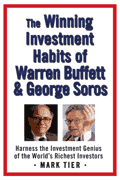
I only had 38 emails going into today compared to the usual 450 (mainly because of having a 4 day week and actually not having such a crazy schedule that I couldn’t answer them during the week) so I’ve been able to spend the past ten hours reading The Winning Investment Habits of Warren Buffet and George Soros, a book I picked up yesterday. The author Mark Tier has come up with 23 investment habits of the ‘Master Investor’ that both Soros and Buffett have shown. Tier also talks about the background, styles, trades, and philosophies of Benjamin Graham, Carl Icahn, John Templeton, Peter Lynch, Philip Fisher, Jimmy Rogers, and Jesse Livermore. I’d say the book was good and would recommend it to anyone fairly new to investing or someone looking to understand how to control the psychological and emotional side of investing and be presented with a view of different systems that have been effective. I would probably not recommend it to an advanced investor with many years of experience, unless they feel like they are in need of focusing on improving their emotional control and are looking for a new systems.
I wanted something that could present a fairly simple and straightforward strategy while helping me develop the mental guidelines to not let emotions control investment decisions. My only suggestion for improving the book would be for it to provide more information on the specific how’s of getting started with a strategy.
The depth of the history behind Buffett and Soros’ trading philosophies that Tier shared was very interesting and inspiring. I find it quite amazing how Buffett and Soros have been able to obtain 24.4% and 28.2% average annual investment returns since 1956 and 1969 respectively. While I have read books about and by Buffett before, after reading this book I know even more that I am much more attuned to the Buffett style of fundamental investing compared to the Soros style of technical investing–though some of his investing based on economic and geopolitical events I could see myself someday modeling. At the end of the day I prefer looking at P/E, ROE, the competitive landscape, and management quality and investing in companies and people rather than candlesticks or directional momentum arrows.
Personally, I have about 5% of my liquid assets in an account I manage and the rest in an account managed by professional money managers. I will probably keep it that way for a few years as for now I feel my time can best be spent working to build the value of iContact. I do want to keep learning and start to spend an hour or week or so making investment decisions for the TD Ameritrade account, so I figured I would start again by reading a book that can help me simplify and add to my personal equity investing beliefs. I have followed the philosophy of Buffett (value investor based on fundamentals) in public equity investing so far (as well as some safer index fund strategies) and wanted to learn more about his strategies.
Until I have much more time to devote to the effort, I will likely never come close to reaching the percentage return levels from public company investing that I can achieve in investing in my own private company (being an ultimate inside investor as Kiyosaki calls it), but someday I would enjoy managing a fund that invests in both public and private companies–so I figure I should keep learning a little bit here and there as I can. Some of the topics in the book like competitive advantage, control-over-emotion, and stock evaluation will be helpful in the continued day-to-day building of iContact.
Now wanting to learn more about the specific Buffet strategy of value-based fundamental investing, I will probably try to find a book that details how to develop a system based on this philosophy and how specifically to find great companies with great teams at periods during which their stock is undervalued by the market. I do have three questions after reading the book that I would welcome any advice on in the comments:
- How does one know when a company is trading at a stock price that is sufficiently low to buy shares. What quantitative measures other than ROE, P/E are good to look at and what are the targets for these figures? What qualitative measures other than competitive landscape and management quality are good to look at? Obviously Buffett wants to buy companies that are valued at less than the present value of their future cash flow–but what are the main determinants in predicting cash flow 10 and 20 years out?
- Tier spoke a lot in his book about Buffet and others going to talk to management teams before making buying decisions. I am a bit unclear regarding the rules for what constitutes illegal insider trading in the U.S.? How is it that you can speak to the management teams to get insight on their business and their competitors’ businesses without it being classified as illegal insider information that you cannot trade based on?
- Tier talks about taking losses quickly, beating a hasty retreat and admitting mistakes, but what is Buffet’s guidelines for getting out and admitting a mistake? Per page 85 he says When the business no longer meets his criteria. When it’s broken and we can’t fit it. To me, this means a fundamental shift in the company’s management, earnings results, or product prospects–and nothing to do with the price. Is there a metric-based guideline that is good to have (10% earnings drop, 15% price drop). How do you know when to admit your mistake and move on in a public equity investment?
Below are my notes from the book. Off to write up my Directors’ Report for last week and compile survey results. I truly do love Sundays.
Notes from The Winning Investment Habits of Warren Buffet and George Soros by Mark Tier
- Don’t buy a stock when you expect the price to go up. Buy it when it meets your investment criteria.
- Intriguingly, often when the market is collapsing, investment professionals suddenly discover the importance of preserving capital and adopt a wait and see attitude, while investors who follow the first rule of investing, never lose money, are doing the exact opposite and jumping in with both feet.
- When you can’t find an investment that meets your criteria, don’t invest at all. Put it in T-bonds.
- Only invest when you can buy at a price significantly below your estimate of the business’ value. (the margin of safety)
- Buffett’s only concern is whether his investments continue to meet his criteria. If they do, he is happy–regardeless of how the market might be valuing them. He simply doesn’t care what the market is doing. He wouldn’t mind if the stock market closed down for 10 years.
- Graham’s ideal investment was a company that could be bought at a price significantly below its liquidation or book value
- Anecdote about Mr. Market and his whims and changing emotions. The more manic-depressive his behavior, the better for you. At times he falls euphoric, at other times he is depressed.
- Mr. Market is there to serve you, not to guide you. It will be disastrous if you fall under his influence. Use your own, independently derived standard of value for determining when a business is cheap or expensive.
- One way or another, the market is always wrong.
- Buffet started with Graham’s model but became influenced by the Fisher model starting in 1963 with his purchase of American Express (after his partner Charlie Munger’s influence, who he met in 1959).
- Fisher – Reading the printed financial records about a company is never enough to justify an investment. One of the major steps in prudent investment must be to find out about a company’s affairs from those who have some direct familiarity with them.
- Fisher – If the job has been correctly done when a common stock is purchased, the time to sell it is–almost never. His average hold was 20 years.
- There are only 3 times to sell a stock–when you’ve found you made a mistake, when the stock no longer meets your criteria, or when you find a fantastic opportunity and the only way to buy it is to sell some stock.
- If there is one factor that sets the Master Investor apart, it is the amount of thinking they have done.
- To Buffett, a company’s worth is the present value of it’s future earnings.
- Companies that focus on making their moats (of competitive advantage) wider and deeper, and fill them with piranhas, crocodiles, and fire-breathing dragons, are what Buffett is after.
- Diversification is for commoners.
- The right amount of a good investment to buy is as much as possible
- Diversification is a protection against ignorance. It makes very little sense for those who know what they’re doing. — Warren Buffett
- The opposite of diversification, concentration in a small number of investments–is central to both Buffett’s and Soros’ success.
- To Soros, investment success comes from preservation of capital and home runs.
- Soros incorporated the Quantum Fund in a tax haven, the Netherland Antilles, so it can compound its profits tax-free.
- How did Soros and Rogers find stocks? They read. Intensely. Trade publications like Fertilizer Solutions and Textile Week were common.
- Read annual reports of the companies you plan to buy–as well as those of their competitors.
- You make your money when you buy
- Monitoring your investment after you make it is just as important as buying
- Story of Harold saying, How would you like to be the target of a class-action lawsuit on behalf of the minority shareholders for failing to maximize this company’s value?
- The Master Investor has the patience when he can’t find an investment that meets his criteria to wait indefinitely until he finds one that does.
- Soros insists on formulating a written thesis before taking a position.
- Soros – To be successful, you need leisure
- The Master Investor acts instantly when he has made a decision.
- The Master Investor never makes an investment without first knowing when he is going to sell (based on pre-set criteria)
- The Master Investor almost never talks to anyone about what he’s doing. He is not interested or concerned with what others think about his investment decisions.
- In evaluating people, you look for three qualities: integrity, intelligence, and energy. And if you don’t have the first, the other two will kill you. – Buffett
- Warren gets people to work their butts off after he buys the business. Now that’s a good skill to have.
- Buffett’s two roles are 1) capital allocation and 2) to motivate people to work who simply have no need to
- One of Buffett’s conditions when he purchases control of a company is that the existing owners stay on to manage it. Part of his success is choosing to only do business with people who simply love their work the way he does.
- Munger – I had a considerable passion to get rich. Not because I wanted Ferraris–I wanted the independence.
- If you are inspired by what you do, then any money you make while pursuing your goals is merely a side effect.
- Buffett – Money is a byproduct of doing something I like doing extremely well.
- When Soros burned out in 1981, he was already worth $25 million, but he had no accomplished what he set out for in life.
- Soros wants to write a book that will be read for as long as civilization lasts.
- For Buffett and Soros, making money is a means to an end, not an end in itself.
- The artist has a vision of his painting–of his ultimate goal. When he paints, his focus is on his craft, on the way he applied his brush to the canvas. He is absorbed by the process of paining. When he is totally involved in what he is doing, the master painter enters a mental state called flow. Flow is a state where absorption is so complete that one’s entire mental focus is on the task being performed.
- Buffett- The first question I always ask myself about a business owner is: Do they love the money or do they love the business, because the day after I buy a company, if they love the money, they’re gone.
- Neither Buffett nor Soros have passed the Series 7 exam. Soros took it and failed. Buffett was the CEO of Salomon Brothers and never took it.
- The Master Investor puts his net worth on the line and has most of his net worth in his company.
- Carl Icahn’s strategy is took take large positions in ‘undervalued’ stocks and then attempt to control the destinies of the companies in question by a) trying to convince the management to liquidate or sell the company to a white knight b) waging a proxy contest, or c) make a tender offer or and/or d) selling back our position to the company.
- They buy companies trading at or below book or liquidation value where no one including incumbent management had a significant stake in the company.
- He would create confusion in the market place by talking and talking and talking to keep the management off guard–he would sow confusion.
- Alfred Kingsley joined Icahn as his associate in 1968
- They then seek a seat on the board. Icahn is actively involved in creating his own exit path by finding the highest bidder.
- Icahn’s biggest mistake was buying TWA in 1985
- Templeton – Buy in bear markets. The best time to buy is when the markets are down and most investors, including the professionals are too scared too invest.
- Templeton got a Rhodes Scholarship after finishing an economics degree at Yale
- Templeton moved to the Bahamas so he could live there tax-free. Templeton views his money as a sacred trust that he can use to help other people.
- Templeton shorted individual dot com stocks in January 2000 systematically 11 days before the 6 month lockup period was set to expire and made $86 million.
- Buffett and Soros believe that they deserve to succeed and make money and that they are in control of their own destiny.
- The strategies were: Buffett-Buy a good business that can be purchased for less than the discounted value of its future earnings. Soros: Buy (or sell) an investment that can be purchased or sold prior to a reflexive shift in market psychology/fundamentals that will change its perceived value substantially. Icahn – buy a company with no controlling shareholder trading below its breakup value that’s a potentially appealing candidate for a takeover. Graham – buy a company that can be purchased for substantially less than its intrinsic value.
- One investment approach is to find good investments by reading and then talking to managers, competitors, retailers, suppliers, and others in the business.
- A complete investment system has detailed rules covering what to buy, when to buy it, what price to pay, how to buy it, how much to buy as a percentage of your portfolio, monitoring the progress of your investments, when to sell, portfolio structure and the use of leverage, search strategy, protection against systemic shocks such as market crashes, handling mistakes, what to do when the system doesn’t work
Collegiate Entrepreneurs Organization Keynote 2007
October 23, 2007
Here’s an excerpt video clip from my keynote speech at the Collegiate Entrepreneurs’ Organization Annual Conference in Chicago. Enjoy!
“Entrepreneur Ryan Allis dances to Crank That Soulja Boy during the middle of the Collegiate Entrepreneur Organization keynote speech, Finding The Purpose of Your Life in Six Lessons, presented November 3, 2007 at the McCormick Conference Center in Chicago in front of 800 college entrepreneurs.”
Keynote at CEO: Finding Your Purpose in Life
October 23, 2007
Here is the slide deck from my keynote speech on Saturday afternoon at the Collegiate Entrepreneurs Organization Annual Conference(7MB).
The speech was titled Finding The Purpose of Your Life in Six Lessons. I had a blast giving the speech. I can’t say I’ve ever danced to Soulja Boy in front of 800 people.
The accompanying music for the slides is Yeah by Usher Feat. Lil Jon and Crank That Soulja Boy by Soulja Boy.
Here’s the BHAG gorilla…

Who Are YOUR Role Models?
October 23, 2007
Who Are Your Role Models?
I’ve given some thought to the people I follow, read about, and try to learn from. While we all have faults, secrets, and imperfections, there are a good two dozen people that I consider today to be my role models in a few different fields.
The question I want to know is who are YOUR role models? Who should I consider starting to follow and learn more about that isn’t on this list? Would you leave the names of your role models in the comments?
Here’s to all the solemn souls who have cared for humanity that have come before and all those blessed brothers and sisters who come after. Here are my current role models.
SOCIAL ENTREPRENEUR/ACTIVIST ROLE MODELS
Mahatma Gandhi (The non-violent revolutionary)
Mother Theresa (The lady who cared for the sick and poor)
Martin Luther King, Jr. (The Man with a Dream)
Susan B. Anthony (Civil rights and suffrage leader)
Paul Farmer (Doctor for the Poor, Mountains Beyond Mountains)
Mohammed Yunus (Banker to the Poor)
Dennis Whittle (Founder of Global Giving)
Bill Drayton (Founder of Ashoka)
Matt Flannery (Founder of Kiva)
Jessica Jackley Flannery (Founder of Kiva)
Dan West (Founder of Heifer International)
Bernard Kouchner (Co-Founder of Doctors Without Borders)
Kerry Kennedy (Human rights activist)
Laura Arrillaga (Venture philanthropist)
BUSINESS ROLE MODELS
Bill Gates (the innovator and hard-line businessman)
Jeffrey Skoll (the eBay founder and social entrepreneur innovator)
Warren Buffet (the smartest fundamentalist around)
Marc Benioff (the SaaS phenomenom-maker)
Marc Andreessen (keeps hitting home runs)
Steve Jobs (he comeback kid)
Larry Page (the technologist and business innovator)
Sergey Brin (the dynamic duo part deux)
Richard Branson (loses his virginity every day)
Thomas Edison (succeeded by failing 3,635 times)
Steve Jurvetson (the VC gadget-lover)
Andrew Carnegie (the library funder)
J.P. Morgan (the financial system saver)
John D. Rockefeller (the competitor)
John D. MacArthur (the PBS funder)
Sam Walton (the great retailer, scaler, and SIFE founder)
Henry Ford (his ability to scale, not him per say)
Larry Ellison (his ability to sell, not him per se)
Tom Perkins (his ability to put together venture deals, not him per se)
Jimmy Wales (the maker of ubiquitous information)
ECONOMIST ROLE MODELS
Jeffrey Sachs (End of Poverty, Common Wealth)
Hernando De Soto (The Mystery of Capital)
George Soros (Open Society)
Milton Friedman (Capitalism and Freedom)
John Maynard Keynes (The General Theory)
JOURNALIST/AUTHOR ROLE MODELS
Tom Friedman (Lexus and The Olive Tree)
John Perkins (Confessions of An Economic Hitman)
Robert Kiyosaki (Rich Dad Poor Dad)
Napoleon Hill (Think and Grow Rich)
Jim Collins (Good to Great)
POLITICAL ROLE MODELS
Abraham Lincoln (The Uniter)
Benjamin Franklin
(The Inventor)
John F. Kennedy (The Dreamer)
Benazir Bhutto (The Fighter)
John McCain (The Fighter)
Barack Obama (The Changer & Inspirer)
Al Gore (The Authentic)
Bill Clinton (The World Changer)
Jimmy Carter (The Carer)
Hillary Rodham Clinton (The Courageous)
Mario Cuomo (The Speaker)
…And anyone who worked or is currently working to increase human prosperity, ensure an economically prosperous and sustainable world, and reduce human suffering, poverty, disease, warfare, and genocide.
Who do I need to know about??? Who’s doing amazing things??? Leave a comment…
The Superficial Luxurious Degeneration of America?
May 20, 2007

I’m in Las Vegas for the second time about to get on the plane home. I was here for a web marketing conference called PubCon. I’ve enjoyed my time here. I saw the Blue Man Group and the Wayne Brady Show. I also did the all-American thing and lost $100 at the blackjack tables after a poorly executed Martingale strategy on the $5 tables at the Sahara. I leave, however, feeling the same way I felt last time–a bit dirty, a bit uncomfortable.
I’m disappointed with the excess and waste of the Westernized luxury culture. Wealthy men with fake-as-can-be paid escorts on each arm at the $5000 per hand blackjack tables, faux-venetian canal boats, Rolex, Prada, Burberry, and Louis Vuitton stores galore, Ferrari and Maybach dealerships, swinger clubs with $65 entrance fees, men on the streets passing out cards with naked women available for between $35 and $150.
I wonder to myself–Does this city in many ways represent a key part of what is wrong with our culture or a key part of the freedom that causes it to thrive? I am as pro-competitive market economy as the next guy, but I have to wonder what role do super-luxury goods play in a just society. I’m not talking about the $200 purses or $40,000 cars–the splurges that perhaps are bad within the realm of defensible-reason in moderation for quality or happiness-inducing reasons. I’m talking about the $10,000 purses and $500,000 cars.
I was taught in my economics education that societies should work to maximize utility. But whose utility does it maximize to spend $75,000 on a diamond necklace in which the original diamond miners in the DRC were paid $10 to mine the raw materials for? The purchasers? What benefit could the male purchaser of a diamond necklace of this cost gain other than the ephemeral loyalty of an ever-expecting superficial person? It is not my place to judge or question their morality, but I must wonder.
Are there not so so so many better things to invest money into other than temporarily attractive fake parasitic members of the opposite gender? And trust me, I’m not talking about women in general, just a very specific type of women that happen to be all over Las Vegas and Beverly Hills. And some wealthy women are just as guilty as the wealthy men. If the advertising and celebrity indoctrinated culture of spend-and-trash materialism didn’t create false desires to ‘be better’ and ‘have more’ could we perhaps focus our investments on something that actually matters to our society?
Could we focus our efforts and funds instead on education, healthcare, and nourishment for the 26 million children who die every day on our highly-optimized six-sigma logistically perfected world from preventable disease and starvation? I’m not talking about giving questionable ideology-inspired bilateral or multilateral aid to dictatorial governments that don’t represent their populace. I’m talking about giving directly to proven projects in our community, country, and world run by local entrepreneurs through groups like GlobalGiving, Kiva, UNICEF, UNESCO, Doctors Without Borders, Heffer International, and Save the Children. Could awareness of the dire situation of so many of our fellow sisters and brothers reduce the demand to waste money on super-expensive non-necessary junk?
But then I came back to questioning myself. What right do I have to question the utility-maximizing choices of ultra-rich people? If they want to spend 1% of their income on a $500,000 car, shouldn’t they be able to? Isn’t the freedom to do just that an ingrained part of our American culture? Is it fascist to even suggest that we should create a society in which it would not be legal to buy a $500,000 car?
I have to agree–we should not make it illegal to buy a $500,000 car or a $10,000 purse. That wouldn’t jibe with the values of our liberty-based democratic republic and market economy regardless of how wrong or wasteful it may be. Our country was also built on the value of equality of opportunity, however. And equality of opportunity surely does not exist quite yet in America.
So perhaps instead of regulating the supply side of the equation we should work on reducing the demand side of the equation. If we can create a consciousness of the realities in our world today–and create a shared awareness of what is actually important (family, friends, health, laughter, memories, the ability to create, a sense of shared humanity, an end to genocide and warfare, environmental sustainability, an end to extreme poverty and hunger, and the prevention of preventable diseases), we may be able to create a world in which the super-luxury wastefulness of the Westernized Vegases, Macaus, and Dubais can legally exist, but end up being destinations that focus on entertainment rather than superficial luxurious waste. Is possible to have entertainment without super-luxurious waste? I think so. Is it unrealistic to attempt to reduce the demand side if we agree we should not regulate the supply side? Can a committed society actually build national human consciousness over a period of decades? I am not sure.
I sometimes wonder, is celebrity culture actually more interesting than the natural drama of the future of the world? I see lots of Entertainment Tonight shows but very few United Nations Tonight shows. Maybe the issue is how the news is presented. Perhaps we need to popularize and dramatize the storylines of the world’s future. Perhaps we need a new form of realtainment that combines The National Enquirer with The Economist. ‘Pakistani Inflation Worry’ turns into ‘Smack-Down Out East: Will Musharref Bodyslam His Central Banker?’ The Current Channel on cable has done a good job at this–but it just doesn’t reach enough people.
With all due respect to Nickelback, at the end of the day who really wants to be drugged up rockstars living in hilltop houses and driving fifteen cars with girls coming easy and the drugs coming cheap? I don’t want a brand new house on an episode of Cribs nor a bathroom I can play baseball in with a king size tub big enough for ten plus me. I think, and I may be wrong here, that the large majority of people want to be happy with friends and family around them and the knowledge that they’ve made a difference in our world.
The government, businesses, and the media tells us to ‘be American’ and buy, buy, buy. The goods end up quickly in landfills. Until the full cost of producing products is internalized instead of externalized in the Generally Accepted Accounting Principles we will be incented by misaligned priorities. Hurricane Katrina was a terrible disaster that had an immense human and environmental effect–and yet it increased our GDP due to the cost of rebuilding. That wasn’t economic growth–that was economic recovery. We’re adding revenue to our asset column without first subtracting the associated expenses from the liabilities. We’re off-balance sheet financing our future.
As a final thought, perhaps we shouldn’t focus on Gross Domestic Product (GDP) but rather Net Domestic Product (NDP), the GDP minus the costs to replace the non-renewable environmental resources that are used up in producing the input goods and final goods. If we invested in companies on the NASDAQ and NYSE based on their EAARC (earnings after all real costs) instead of their EBITDA we would be a lot closer to having a market that valued companies appropriately based on their contribution to their customers and society.
I’ll end this essay with a quote from the comedian George Carlin. While I enjoy living in the fast paced globalized technology-driven business world as much as anyone—I agree with his core message…
The paradox of our time in history is that we have taller buildings but shorter tempers, wider freeways but narrower viewpoints. We spend more, but have less, we buy more, but enjoy less. We have bigger houses and smaller families, more conveniences, but less time. We have more degrees but less sense, more knowledge, but less judgment, more experts, yet more problems, more medicine, but less wellness. We drink too much, smoke too much, spend too recklessly, laugh too little, drive too fast, get too angry, stay up too late, get up too tired, read too little, watch TV too much, and pray too seldom. We have multiplied our possessions, but reduced our values.
We talk too much, love too seldom, and hate too often. We’ve learned how to make a living, but not a life. We’ve added years to life not life to years. We’ve been all the way to the moon and back, but have trouble crossing the street to meet a new neighbor. We conquered outer space but not inner space. We’ve done larger things, but not better things. We’ve cleaned up the air, but polluted the soul. We’ve conquered the atom, but not our prejudice. We write more, but learn less. We plan more, but accomplish less. We’ve learned to rush, but not to wait. We build more computers to hold more information, to produce more copies than ever, but we communicate less and less.
These are the times of fast foods and slow digestion, big men and small character, steep profits and shallow relationships. These are the days of two incomes but more divorce, fancier houses, but broken homes. These are days of quick trips, disposable diapers, throwaway morality, one night stands, overweight bodies, and pills that do everything from cheer, to quiet, to kill. It is a time when there is much in the showroom window and nothing in the stockroom. Give time to love, give time to speak! And give time to share the precious thoughts in your mind.
NC IDEA Funding
May 23, 2006
Broadwick closed on $500,000 in an initial round of funding today with local investment firm NC IDEA. We’re quite excited about the financing. Additional coverage can be found at the LocalTechWire, Triangle Business Journal, Carolina News Wire, and Tech Journal South.
Recent Comments