


This Page May Contain Content That is Not Consisent With the Moral Cultural, or Social Values of the UAE
June 23, 2008

I was in Dubai for a night two weeks ago on my way to Uganda and tried from my Holiday Inn Express in Dubai Internet City home of the Middle East campuses of Sun Microsystems, Cisco, and EMC and to access a blog called Secret Dubai Diary. The site came up in a Google search for Dubai nightlife. When I tried to access the site, I got the lovely “Surf Safely” message above, indicating that this site was “inconsistent with the moral, cultural, or social values of the UAE.” Unfortunately for the government censors in the United Arab Emirates, they didn’t think to block the Google Cache version of the page.
It was very reassuring that UAE recognizes the Internet as a “powerful medium of communication, sharing and serving our daily learning requirements.”
If you wish, you can send an email to “safesurf[at]du.ae” to share your view of Internet censorship.
How to Be a Public Company CEO
May 23, 2008

I’m out here at the Pacific Crest Technology Leadership Forum in Vail, Colorado this week. The 600 attendees here are a mix of public institutional investors, hedge fund managers, investment bankers, public company analysts, venture capitalists, public company CEOs and CFOs, and private company CEOs and CFOs.
The investors are here to meet the management of the public and soon-to-be public companies and to build relationships with the people that feed them data about these companies–the analysts. The analysts are here so they can publish research on these companies to sell to the investors. The investment bankers are here to build relationships with the management of companies they hope to sell, advise on acquisitions for, take public, or do follow-on offerings for. The CEOs and CFOs are here so they can raise money from the investors and get covered by the analysts. It’s a fascinating dynamic.
I’m learning how to be public company CEO. Here are some of the things I’ve learned.
The Process of Going Public
The general process of taking your company public in the United States is:
- Build your company to at least $40M in annual sales (the sort-of-hard ‘takes 7 years’ part).
- Reach breakeven or profitability and have solid positive EBITDA in sight.
- Invite investment bankers to pitch you in what’s called a ‘bake-off’
- Buy labels and write on them the price of your cakes and cookies
- Select two of the following ‘bulge-bracket’ investment bankers to ‘bookrun’ your initial offering of shares: Goldman Sachs, Morgan Stanley, Credit Suisse, Deutsche Bank, Merrill Lynch, Lehman Brothers, UBS, Citigroup, and JP Morgan
- Select two to three ’boutique’ investment bankers to ‘co-lead’ your initial offering of shares such as Pacific Crest, Jeffries, Piper Jaffray, William Blair, Cowan, Needham (there are dozens and dozens)
- These four or five banks form your ‘underwriting syndicate’ (the people who help you ‘make a market’ for the percentage of your company that you are selling to the public by taking initial orders from institutional investors).
- Meet with your bankers to write your ‘Form S-1‘ which is a couple hundred page document detailing every part of your business, every product, every management team member, every metric, every material agreement, every options plan, every differentiation, every risk etc.
- Determine which exchange you wish to list on. The NYSE has higher revenue requirements than the NASDAQ. The NASDAQ is weighted toward technology companies. NYSE ARCA and NYSE Euronext are also options for smaller offerings, as is the AMEX. The London Stock Exchange (AIM) is also sometimes an option, though it requires different filing steps and doesn’t presently provide the branding imprimatur or liquidity that a New York exchange does.
- Presuming you are going public on an American exchange, file your S-1 with the Securities and Exchange Commission.
- Publicly announce your registration and your intent to go public.
- Respond back to the comments and questions that the SEC provides until they tell you you are good to go.
- Determine with your bankers which metrics and the definition of each metric you will report to ‘the Street’ (the institutional investors that will buy/sell your shares and analysts which will cover your company once it’s public). You will have to report all financials (bookings, revenue, GM, COGS, Cap Ex, R&D, Sales & Marketing, General & Admin, OpEx, Net Profit, EBITDA, assets, liabilities, ARs, APs) and numbers such as customers, growth rate, ARPU, retention/churn, LTV, and CAC.
- Work with your bankers to craft your story and prepare your slidedeck for the roadshow, emphasizing your strengths, metrics, and opportunity.
- If the market timing is good then prepare for your roadshow. The market is rather bad right now (August 2008) for IPOs. There have been no venture-backed IPOs to date in 2008, although there will likely be a few in Q4 and many in 2009.
- Determine your initial price per share target and how much money you wish to raise, and the percentage of the company you wish to sell to the public market.
- Hold an ‘IPO roadshow’ in which you and your CFO visit the major U.S. cities to present to the institutional investors and mutual fund managers who may wish to purchase your shares.
- At this point your ‘bookrunners’ will take orders for shares and help build interest among firms that they know have demand for businesses like yours.
- Based on demand (# of orders) you and your investment bankers make a final determination on price per share, amount of shares to sell, and who to sell shares to (ideally stable investors that won’t trade out of your stock right away) the night before or the morning of the listing.
- Ring the bell the morning of your offering and celebrate. Watch the wire of funds go into your corporate bank account. Now the work begins to properly manage expectations, overperform, and gain trust with your investors.
The Advantages to Being Public
The advantages to going public are generally greater access to capital to help grow the business, liquidity for pre-IPO shareholders (though not for at least 6 months after the offering), an ability to command a higher revenue multiple than most private companies can, and a greater level of trust and respect among larger customers or vendors.
The Disadvantages of Being Public
The disadvantages of being a publicly traded company include the 3 months of time you as CEO will have to be fully focused on going public and the 6 months your CFO will have to be fully focused on the process of going public–causing you to lose some focus on operations, having to report many of your key metrics and strategies to the public–including your competitors, having to ‘manage to the Street’ or in other words manage your results and report every quarter which sometimes causes short-term thinking, an inability to be fully flexible, the legal reporting requirements of Sarbanes-Oxley that cost around $2 million per year in compliance costs, and a requirement to be profitable or within clear visibility of profitability that sometimes can limit ability to pursue growth.
Some Tips for the Public Company CEO To Be
Here’s a few tips I’ve picked up here at the conference on being a public company CEO.
- Manage Expectations Well: Become very good at managing expectations. As a public company CEO your job is to consistently hit or outperform your revenues and earnings per share (EPS) guidance every quarter. It takes time to develop trust with institutional investors. And if you go out saying one thing and end up not hitting that plan and doing another, it will cause turnover among your shareholder base, which will cause your share price to go down (bad). To become very good at managing expectations, make sure you have a solid financial model in place that can very accurately model future revenues, bookings, gross margins, and earnings projections. Don’t go out indicating you’ll have 10% net profits and then decide that you’re going to have 3% net profits so you can grow faster.
- Build Relationships Before You Need Them: Just as with raising venture capital, build the relationships before you need them. Start going to the analyst and investment banker conferences at least 18 months prior to your offering and build relationships with both the ibankers and public investors. Make sure they know who you are and like you and the company story many months prior to the roadshow.
- Pick Sticky Investors: When you are going out, you’ll decide which institutional investors get to purchase your stock and which do not. Ask in your contract with your investment bank that you significant input if not have final say as CEO. Get to know in advance which firms are long-term investors and which are not. You can use a service like the ‘Business Intelligence’ offering from Thompson Reuters to determine which institutions are looking at your deck and materials. Pick the firms that are going to hold your stock and not have high share turnover. Be wary of hedge funds who have high portfolio turnover.
Hope you enjoyed the post! I’ve still got a lot to learn so please let me know in the comments what I’ve mis-stated or altogether missed. Man I love this stuff.
Tom Friedman: Why We Need a Green Revolution, And How It Can Renew America
May 23, 2008
What is next after the Information Technology (IT) revolution of the last 30 years?
Well, according to Thomas Friedman, it’s the Energy Technology (ET) revolution.
Last Monday I had the chance to hear Mr. Friedman give an impassioned presentation at Duke’s Terry Sanford Institute for Public Policy. I made the following notes from Tom’s presentation about his new book, Hot, Flat, and Crowded. All of the below viewpoints are not necessarily mine, but I do very much share his stated urgency for encouraging investment in energy technology.
======
The Emperor Has Lost Her Groove
Hot, Flat, and Crowded masquerades as a book about energy and the environment. In reality, it’s a book about American losing its way, losing its groove. American has lost her groove over the past 15 years due to:
- Our reaction after 9/11–going into the Iraq War
- The loss of a superpower competitor in the USSR
- Our government not operating efficiently since Bush was elected
We have become the United States of Fighting Terrorism instead of the The United States of America. Our day should be July 4th not September 11th. The government in Washington D.C. simply has been unable to solve long-term multigenerational problems any longer. The U.S. is as innovative as ever, but the government is not maximizing this opportunity.
Energy Technology will have 10x the impact Information Technology had. We need a common vision. What ‘red’ was as a coordinating force in 1950, ‘green’ must be 2008. But instead of going from red to green we’ve gone from red to code red–to a politics of fear.
Meaning of the Title
The significance of the title is:
- HOT – Global warming, the climate system is sensitive. There is only 6 degrees celsius between the ice age and today.
- FLAT – The rise of the middle class all over the world
- CROWDED – Population growth. 2.6B people in 1953 when Friedman was born. 9.2B people in 2053 when he reaches 100 years old. Fuels that we are using today are expensive, exhaustible, and toxic.
The 5 Megaproblems Our World Has:
Key to the book are the five megaproblems our world has. They are:
- Energy and Natural Resources Running Out
- Petrodictatorship
- Climate Change
- Energy Poverty
- Biodiversity Loss
1. Energy & Natural Resources Running Out When flat meets crowded, in an unsustainable world, watch out! There are skyscrapers blossoming from the desert floor in Doha, Qatar. In the 4 years since he was last there, Doha has sprouted a Manhattan. In another city you haven’t heard of, Dalian, China, they’ve also sprouted a Manhattan. That clean air initiative in Vermont was just wiped out by unsustainable growth in a place you probably haven’t heard of.
2. Petrodictatorship
This is the concept of oil revenues leading to great power for semi-elected or unelected leaders/dictators, leading to worse relations with the United States. As price of oil goes up, freedom for oil producing countries goes down. When oil was at it’s de minimus point in 1995 at $16 per barrel, the index of freedom was at its highest in countries like Nigeria, Venezuela, Russia, and Iran. As oil prices have gone up, freedom has declined.

3. Climate Change
The weather will get weirder. The droughts will get longer. The hurricanes will get bigger. There is so much CO2 being released into the atmosphere, we don’t know any more what is an act of God and what is an act of man. Did ‘we’ make Katrina or did ‘He’ make Katrina?
Al Gore should apologize to the world. He should apologize that he underestimated the problem of climate change. Due to China growing faster than initially projected, the original estimates from five years ago were too low. There’s one good thing about healthcare getting better over time–All the climate change deniers are going to live long enough to find out how wrong they were.
4. Energy Poverty
25% of the world is not yet on the electric grid. In China, every 2 weeks generates as much new electricity as sub-Saharan Africa in 1 year, excluding South Africa. Without energy you will fall behind as a society exponentially–in education, healthcare, technology. To be energy poor will be problematic–for us and for ‘them.’
5. Biodiversity Loss
We are the first generation of humans who are having to think like Noah–having to think about saving the last two pair of every species. We are losing thousands and thousands of species that will inhibit our ability to find new medicines.
Problems or Opportunities?
There are two ways to look at this list. Either they are A) Insoluble Problems or B) Incredible Opportunities.
The solution is simple: Abundant, Clean, Cheap, Reliable Electrons. The country that comes up with abundant, clean, cheap, reliable electrons will have the most global respect and the most financial success. America can be this country. We have to rethink green. We are positioned to lead this revolution. Green is the new Red, White, and Blue. Green is the new Patriotism.
The Green Revolution or The Green Party?
Some say we’re in a green revolution already. But no, we’re just having a green party. There’s never been a revolution without someone getting hurt. You’ll know the revolution is here when someone gets hurt. Not physically–but financially. Just like NCR and DataGeneral died when they did not evolve in the IT Revolution and ended up in the Great IT Heaven In The Sky. The world is flat, so change or die, adapt or die.
This is not yet a revolution. It’s a green party. I know–I’m invited to them all.
This revolution will not be easy. It will be the greatest industrial project mankind has ever undergone.
How Do We Stimulate the Revolution Before It is Too Late?
How do we go about finding solutions? We have to innovate our way out of the problem–through the American Marketplace, U.S. universities, and venture capital. We have to find the next ‘Green Google’ and ‘Green Microsoft.’
We need government stimulus however, and here’s why. In the IT Revolution, it was a greenfield opportunity. There were no microcomputers previously. There was no Internet previously. There was nothing to replace. In the ET revolution, there’s existing competition, existing competition from dirty fuels that today are slightly cheaper in the short term, but much more expensive in the long term.
In order to stimulate the start of the ET revolution the Government must force us to take into account the true full cost of dirty fuel. If we do this, we will reach the China Price–the price at which ET will scale in India and China. We need to pay the ‘fully burdened’ cost of the lights. Only the government can do this. This policy will drive immense investment in clean ET and ET will go down the price/volume curve and soon enough become cheaper than we currently pay today.
By putting in a price floor for a barrel oil, for example at $100, firms and investors will be able to make investments in ET without concern that the price will drop and in the short-term they’ll be uncompetitive and die.
By following the policy, the amount the consumer pays over the non-fully burdened cost (if it is less than $100/barrel) would go to the government in the short-term to allow them to invest in ET. This is much better than what happens currently, where the excess goes to petrodictatorships that often work against America’s interests.
Green Revolution Great for American Economy
With higher clean standards, government encouragement, and insurance that the fully burdened price will be charged, the price signals for ET will be right and investment will boom. There is only one thing more powerful than Mother Nature, and that is Father Profit.
As an example, Erie, PA has a export surplus. How does Erie, PA have an export surplus? They have a plan for GE that produces a hybrid locomotive called the EVO. It is in very high demand become it is very efficient with energy. ET is good for the American economy and our trade balance.
We must increase clean standards to force innovations. Standards and price signals matter. If we don’t have a floor under the price of oil, we can’t make investments in ET. In order to launch the Green Revolution and scale, we must do this.
Not About The Whales Anymore
All great change in history was made by optimists. The future is choice, not fate. When you put people together you put the planet together. This is not about the whales anymore. It’s about us. We are all sailing on the Mayflower again.
We must redefine green and rediscover America. $5B in VC went into ET in 2007. But $80B in VC went into IT in 2000. $5B is nothing. We need a game changer. We need standards and a fully-burdened price floor. Then investment will take off.
There’s Now Only One Green Candidate in the U.S. Election
We need the next U.S. President to be a real CEO–a Chief Energy Officer.
As President you have a big bully pulpit. We need him to use it to promote ET. This is the future for America.
I won’t say who I support for President, but let’s just say my wife supports Obama and I love my wife. There’s a guy with 13 cars and a guy with a Ford Escape Hybrid. There’s only one green candidate in this election. We had two, but McCain has changed for the worse under the influence of Drill Baby Drill. Don’t be fooled by windmills in advertisements.
We need to find abundant, cheap, clean, reliable electrons. We need to create green collar jobs–the new blue collar jobs.
How could some people be chanting, “Drill, Baby, Drill.” It’s just stupid. It’s like on the eve of the IT revolution in 1978 someone was chanting “Carbon Paper, Baby, Carbon Paper.” Our motto should be “Invent, Baby, Invent.”
How to Be a Credible Energy Activist
Utilities today are paid based on how much they use. They should be paid on how much they help you save. We need to rewrite the rules for utilities like California and Idaho have.
If you want to be an energy activist, learn what the rules are and how to change the rules. Don’t just protest.
Isn’t it BRICs Turn To Be Dirty?
Brazil, Russia, India, and China might have an argument that we’ve developed dirty for 150 years and now its their turn. I was in China speaking at a conference of auto-industry executives. I said to them, “Sure you can be dirty for the next 20 years if you want. That might save you some money. In the mean time, America’s innovation engine will revolution the world with clean electric cars that cost less and don’t require costly fuel and by the time you wake up we will eat your lunch economically. Sure, go ahead and be dirty.”
China is hiding behind us. If we move, they move.
An Earth Race
We had a Space Race. Now we need an Earth Race. An Earth Race so that man and woman can live sustainably. Without it, we’re dead.
=======
What Do You Think?
What are your thoughts? Is Friedman right? Does he overestimate the problem or is he right on? What do you think about the oil price floor? Please feel free to comment below.

Project Polaroid: Giving A Child Their First Picture | Dare Mighty Things
May 23, 2008
How do you get the attention of a large global company (Polaroid) and convince them to reverse a key strategic decision? Hopefully, like this…
The Birth of Project Polaroid
Nine months ago, in early January, I was hanging out in Charlotte with a friend of mine named Carly. Carly is just 20 and a junior at UNC-Chapel Hill. She is an entrepreneur and a social entrepreneur who runs a photography business, Carly Brantmeyer Photography. We were brainstorming. She wanted to do more than be a student and photographer. She wanted to use her talents and abilities to give back.
Carly had just returned from a Christmas family trip to Costa Rica. There, she took lots of beautiful digital photos. The children were eager to see the picture she just took of them on the back LCD display. She wanted to be able to give the children a copy of their photo, but couldn’t. There was no easy way.
She thought, “If I had a Polaroid camera with me I could give them a copy of the picture right now.”
She returned and while brainstorming at her house in January she came up with Project Polaroid. She would bring hundreds of Polaroid instant film with her to developing countries and give children a picture of themselves–something most of them would never seen before, yet alone owned.
Project Polaroid in Colombia
Carly had the opportunity to visit Colombia over the summer to try out Project Polaroid for the first time. She borrowed my Polaroid camera that was given to me as a gift in 2007 and bought some film. Here are some of the inspiring pictures she took. Take a look especially of the one of the mother, holding a picture of her beautiful young daughter for likely the first time:


Project Polaroid in Uganda
In July, I went to Uganda for a week. Carly had returned from Colombia so I got my camera back the night before. Here are some of the pictures I took.


I was able to take about 60 pictures there while in Uganda while in 4 different locations. Each time I noticed an interesting phenomenon. In one of the locations, I found myself in a small village near the Mirembe Kawomera Peace Coffee Cooperative. This place was about 30 minutes down a dirt road from Mbale, Uganda. I took my first photo of a child and gave it to her. She was very confused as to what it was. I told her to shake the picture. She then ran away, nervous it seemed.
Exactly, on the dot, 3 minutes later, a group of at least eight kids came running around the corner jumping up and down with excitement. The picture had developed! Each time I began taking photos with just one or two children. They would go away, wondering what I had gave them (most Ugandan children in villages speak little English), then come back with their whole crew just 2-3 minutes later when they realized what had been given to them. This run away, see the photo develop, and bring back more children would happen every time. Sometimes, as Carly has experienced, you get surrounded by as many as 40 or 50 children within minutes.
In the village outside of Mbale I also gave away some of the soccer jerseys and shorts that had been donated by Sports Endeavors of Hillsborough, NC, the owners of Soccer.com and Eurosport, through the U.S. Soccer Foundation Passback Program. The children created such a commotion that the villages lone police office came over hurriedly, thinking the children were stealing from the van.
Project Polaroid in Ghana
This fall semester, Carly is living and studying in Legon, Ghana at the University of Ghana, with a study abroad program from UNC. She has received a number of donations to help expand the program and has brought dozens of packs of film. Here are some of the photos she’s taken so far in Ghana:


Polaroid Will Stop Selling Polaroids in Early 2009
For background information, back in 2001, Polaroid Corporation, the makers of the famous Polaroid Cameras and instant film filed for bankruptcy. It’s assets ended up being purchased by a private investment firm, Petters Group Worldwide, in 2005.
Very unfortunately for Project Polaroid, Polaroid announced back on February 8 that it will be phasing out production of its instant film and that it will be completely off the shelves by early 2009. We were of course a bit saddened by this announcement. Polaroid will no longer sell Polaroids. It’s a travesty of sorts and will certainly make the project difficult to scale. Polaroid has said that it will be willing to license its instant film technology to another firm should another firm be interested. Here’s hoping Polaroid somehow comes across this story and they realize the immense value that Polaroid film has to their brand.
Carly writes on her detailed travel blog.
“The idea is simple. $1=1 Polaroid photo, for 1 kid, that will last a lifetime. So many children around the world have never even owned a single photo of themselves. What could be more precious of a memory than a photo of you/your family?”
How You Can Help
When she left, Carly raised money from her family and community. She was able to take a few dozen packs of film with her. A month into the trip, Carly is now running out of film. If you would like to contribute, the best way would be to mail her a pack of two of Polaroid 600 film. She would very much appreciate any help. She will be at the following address until December:
Carly Brantmeyer
University of Ghana
c/o International Programs Office
International Student Housing II
Room #127
Legon, Accra, Ghana
Update: If you’d prefer you can send them to Charlotte where Carly’s mom Lisa has offered to collect them and mail them in one package to Ghana. The address is: 14803 Davis Trace Drive, Charlotte, NC, 28227.
Overall, I am excited to see Project Polaroid in Ghana and look forward to her getting back in January and brainstorming how to scale the project to many more developing countries. Being in Uganda myself in July and seeing the impact owning a simple picture can have in the life of a child and the parents of that child has made a lasting impact on me. One of the children was 3 and didn’t have pants–just a long shirt. He lived in a thatch hut near a school Roey and I were speaking at with his brother, sister, and mother. He didn’t have pants but he was overjoyed with happiness to have the picture. Hopefully we can convince Polaroid to sponsor the project in the future and keep producing instant film.
What We Did in Berlin Today
April 23, 2008
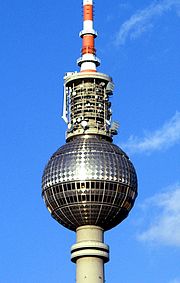
Today in Berlin we met up at 3pm for a walking tour of the city, then ended up at 5pm at the British Council office at Alexanderplatz 1 in East Berlin next to the Fernsehturm television tower that was a major symbol of the GDR in the communist era.
We began at 5:30 with a brilliantly led introduction and ‘The Great Transatlantic Debate.’ We lined up in order of height, grouped into teams of 5, and then separated into planning rooms.
Each of the six teams (we were team 3) had a provided thesis they had to prepare to prove in the upcoming debate. Our team was tasked to prove that ‘the relationship between America and the E.U is strong and getting stronger.’
In our five minutes, Peter Macleod from Canada played the American husband and Angela Brunete from Spain played the European wife. Peter allegorically referred to the EU/US relationship as a marriage in which there were ups and downs but at the end of the day we would always be together. Angela accused Peter of cheating on her with India, and Peter accused Angela of cheating on him with China. But they reconciled as Rabah Ghezali from France shared the cultural and historical ties including the core values of liberal democracies and the Marshall Plan, Dragos Pislaru from Romania shared the strategic and military ties including our recent learnings of what can happen when we don’t truly work together in global conflict, and I shared the economic ties including trade and FDI growth. Team Four proceeded to present the other side of the argument for five minutes, followed by a one minute rebuttal.
Following the debates, we discussed issues including the identity challenge, citizen media, technology and mobility, E.U. enlargement, the relative stasis of the U.S., whether there were 4, 5, or 7 continents in the world (Europeans learn 5), red blue and purple America, the Stockholm consensus, lateral relationships between the U.S. and Eurozone countries, whether the West or East would most define the 21st century, demography, and our shared history.
After the group discussion we held a reception and dinner and followed on with about three hours of networking in the lounge of the British Council’s office. Around 10, Jeff Johnson and I worked to persuade the group to go to ‘Weekend‘ the dance club across the street in the Sharp Aquos building until we found out that GMF was not name of the Sunday night DJ but rather meant that Sunday night was Gay Night–so we headed to Bar Wave at the Novotel instead.
We’re all building some tremendously valuable connections that will help our businesses, non-profits, and public service organizations for many decades to come while broadening our understanding of global challenges and global entrepreneurial opportunites.
I’m off to get back to work on my Sunday night email catchup.
Podcast Interviews on Entrepreneurship
April 15, 2008
Here are two recent podcast interviews on entrepreneurship done by Written Voices and Daxle. Enjoy!
Written Voices Podcast Interview With Ryan Allis (17min 38 sec) – A discussion with Allan Hunkin from Written Voices about:
- Building a team
- My personal motivation
- The importance of finding mentors
- An overview of Zero to One Million including opportunity evaluation, raising capital, marketing and creating sales, giving back, and setting goals
- Finding your core motivation
- Focusing on providing a great product
- Social responsibility
- The Entitlement Generation vs. The Enlightenment Generation
- The Enlightened Entrepreneur
- Finding Your BHALG – Your Big Hairy Audacious Lifetime Goal
Daxle Interview with Ryan Allis (17 min 02 sec) – A discussion with Brian Oates from Daxle about:
- The entrepreneurial itch
- Finding a partner
- Evaluating entrepreneurial opportunities
- Ensuring demand for your business idea
- The value of teamwork
- How internet sales are different from door-to-door sales
- Generating leads from the web
- Bootstrapping and doing what it takes to keep expenses low
Two More Interviews on Entrepreneurship
March 23, 2008
Here are two more recent podcast/radio interviews on entrepreneurship done by Dr. Alvin Jones and Start-Up Spark. Enjoy!
Dr. Alvin Jones Radio Interview with Ryan Allis – (9min 17sec, WMA file) – A March 26, 2008 radio interview on WCBQ-AM 1340 and WHNC-AM 890 with Dr. Alvin Jones from the Paradise Radio Network about:
- Starting in business
- Going to UNC
- Being the son of a priest
- What iContact does
- The quote about taking action by Scottish Mountaineer W.H. Murray
- Setting big goals
- Understanding the entrepreneurial system
- Evaluating business ideas
- The three questions to ask prospective buyers
- Accessing the world of equity capital
Start-up Spark Interview with Ryan Allis (17 min 38 sec) – A discussion with Shannon Cherry from Start-up Spark about:
- Growing up in Florida
- Advantages/disadvantages of young entrepreneurs
- The MAR system
- Bootstrapping and living in the office
- Doing whatever it takes to keep expenses low
- How we hired our first employee
- Using equity initially to reduce cash burn
- The importance of systems and building a team when scaling
- How to avoid creating a job for yourself
- Why hiring people smarter than you is critical
- The definition of an entrepreneur
- Figuring out the purpose of your life
- What will motivate you to get through the hard times
- The mission of The Humanity Campaign
The Opportunity of Our Lifetimes
January 23, 2008
 Our generation–those born in the 70s, 80s, and 90s–has a great opportunity ahead of ourselves. We have the ability for the first time in human history to eliminate extreme poverty within our lifetimes and ensure shared access to prosperity regardless of color, geography, or nationality. This possibility is worthy of a boisterous cheer.
By 2050, we’re projected to have 9.5B humans on this planet, however. Our planet will not allow a world of 9.5 billion humans living in the manner the average citizen of the Western world lives today, yet alone the 6.6 billion we have today.
Here inlies the great connection between sustainability and poverty. Unless we as a global society invest to develop the needed technologies to allow for humans to become sustainable in food, energy, and water production we will end up having less resources than are necessary for 9.5 billion people to live in a world without extreme poverty–let alone a world in which there is true shared prosperity, mutual security, and equality of opportunity. This is the greatest challenge of our lifetime as entrepreneurs, social entrepreneurs, scientists, technologists, and public servants. We must have sustainability to end poverty.
As a friend of mine from high school recent wrote me, “We must work toward the creation of a world where the standard of living, human rights, basic freedoms, and sustainability are all compatible.”
The two billion people that Goldman Sachs projects will be added to the global middle class by 2030 may never make it if sufficient food, energy, and water resources don’t exist. Dominic Wilson and Raluca Dragusanu, showed in a Goldman Sachs Economic Research paper published on July 8 called “The Expanding Middle: The Exploding World Middle Class and Falling Global Inequality” that close to 70 million people a year are entering the global middle class. They define this range as those with per capital income $6,000 and $30,000, purchasing power parity adjusted. They foresee shifts such as:
- Changing spending patterns.
- Increased pressure and competition for resources
- Greater threat of environmental degradation
- Rising environmental consciousness
- Political and social changes
Through one lens, we could have resource wars, strife, famine, and terrible droughts, melting ice caps, biodiversity extinctions, and rising sea levels.
Through the other lens, we could have a world of growing prosperity, security through commerce, and gained respect among cultures and religion, a world of ubiquitous broadband, a world of communications technology that will enable humans to gain a common language and understanding, a world in which dictators can no longer use scare propaganda to wedge the false division of us vs. them, a world in which there is access to education, healthcare, nutrition, and opportunity for all, a world in which entrepreneurship thrives and technology drives improves food production, water access, and non-carbon based energies, a world in which our identity as human is so much more important than what divides us.
We have come to a turning point in history. This is both the challenge of our lifetime, and the great opportunity of our lifetime. How can we enable the great economic and creative potential for all humans while ensuring we leave a world of environmental stability to our grandchildren?
Will we invest in the creation of a new Apollo Plan for Energy? We will create the Global Bill of Rights that provides access to education, healthcare, and nutrition? Or will we fall into a once great society as the benefit of inexpensive petroleum leaves? Will Malthus finally get his way?
Is growing economic prosperity possible in a world of declining resources and increased commodity prices? Does our lifetime end up being marked in history as the time of resource wars, increased poverty, and environmental damage? Or does it end up being marked by global collaboration, shared prosperity, and sustainability. We have a choice.
This is the greatest opportunity of our lifetime, and our greatest challenge.
The Superficial Luxurious Degeneration of America
December 8, 2007
I’m in Las Vegas for the second time about to get on the plane home. I was here for a web marketing conference called PubCon. I’ve enjoyed my time here. I saw the Blue Man Group and the Wayne Brady Show. I also did the all-American thing and lost $100 at the blackjack tables after a poorly executed Martingale strategy on the $5 tables at the Sahara. I leave, however, feeling the same way I felt last time–a bit dirty, a bit uncomfortable.
I’m disappointed with the excess and waste of the Westernized luxury culture. Wealthy men with fake-as-can-be paid escorts on each arm at the $5000 per hand blackjack tables, faux-venetian canal boats, Rolex, Prada, Burberry, and Louis Vuitton stores galore, Ferrari and Maybach dealerships, swinger clubs with $65 entrance fees, men on the streets passing out cards with naked women available for between $35 and $150.
I wonder to myself–Does this city in many ways represent a key part of what is wrong with our culture or a key part of the freedom that causes it to thrive? I am as pro-competitive market economy as the next guy, but I have to wonder what role do super-luxury goods play in a just society. I’m not talking about the $200 purses or $40,000 cars–the splurges that perhaps are bad within the realm of defensible-reason in moderation for quality or happiness-inducing reasons. I’m talking about the $10,000 purses and $500,000 cars.
I was taught in my economics education that societies should work to maximize utility. But whose utility does it maximize to spend $75,000 on a diamond necklace in which the original diamond miners in the DRC were paid $10 to mine the raw materials for? The purchasers? What benefit could the male purchaser of a diamond necklace of this cost gain other than the ephemeral loyalty of an ever-expecting superficial person? It is not my place to judge or question their morality, but I must wonder.
Are there not so so so many better things to invest money into other than temporarily attractive fake parasitic members of the opposite gender? And trust me, I’m not talking about women in general, just a very specific type of women that happen to be all over Las Vegas and Beverly Hills. And some wealthy women are just as guilty as the wealthy men. If the advertising and celebrity indoctrinated culture of spend-and-trash materialism didn’t create false desires to ‘be better’ and ‘have more’ could we perhaps focus our investments on something that actually matters to our society?
Could we focus our efforts and funds instead on education, healthcare, and nourishment for the 26 million children who die every day on our highly-optimized six-sigma logistically perfected world from preventable disease and starvation? I’m not talking about giving questionable ideology-inspired bilateral or multilateral aid to dictatorial governments that don’t represent their populace. I’m talking about giving directly to proven projects in our community, country, and world run by local entrepreneurs through groups like GlobalGiving, Kiva, UNICEF, UNESCO, Doctors Without Borders, Heffer International, and Save the Children. Could awareness of the dire situation of so many of our fellow sisters and brothers reduce the demand to waste money on super-expensive non-necessary junk?
But then I came back to questioning myself. What right do I have to question the utility-maximizing choices of ultra-rich people? If they want to spend 1% of their income on a $500,000 car, shouldn’t they be able to? Isn’t the freedom to do just that an ingrained part of our American culture? Is it fascist to even suggest that we should create a society in which it would not be legal to buy a $500,000 car?
I have to agree–we should not make it illegal to buy a $500,000 car or a $10,000 purse. That wouldn’t jibe with the values of our liberty-based democratic republic and market economy regardless of how wrong or wasteful it may be. Our country was also built on the value of equality of opportunity, however. And equality of opportunity surely does not exist quite yet in America.
So perhaps instead of regulating the supply side of the equation we should work on reducing the demand side of the equation. If we can create a consciousness of the realities in our world today–and create a shared awareness of what is actually important (family, friends, health, laughter, memories, the ability to create, a sense of shared humanity, an end to genocide and warfare, environmental sustainability, an end to extreme poverty and hunger, and the prevention of preventable diseases), we may be able to create a world in which the super-luxury wastefulness of the Westernized Vegases, Macaus, and Dubais can legally exist, but end up being destinations that focus on entertainment rather than superficial luxurious waste. Is possible to have entertainment without super-luxurious waste? I think so. Is it unrealistic to attempt to reduce the demand side if we agree we should not regulate the supply side? Can a committed society actually build national human consciousness over a period of decades? I am not sure.
I sometimes wonder, is celebrity culture actually more interesting than the natural drama of the future of the world? I see lots of Entertainment Tonight shows but very few United Nations Tonight shows. Maybe the issue is how the news is presented. Perhaps we need to popularize and dramatize the storylines of the world’s future. Perhaps we need a new form of realtainment that combines The National Enquirer with The Economist. ‘Pakistani Inflation Worry’ turns into ‘Smack-Down Out East: Will Musharref Bodyslam His Central Banker?’ The Current Channel on cable has done a good job at this–but it just doesn’t reach enough people.
With all due respect to Nickelback, at the end of the day who really wants to be drugged up rockstars living in hilltop houses and driving fifteen cars with girls coming easy and the drugs coming cheap? I don’t want a brand new house on an episode of Cribs nor a bathroom I can play baseball in with a king size tub big enough for ten plus me. I think, and I may be wrong here, that the large majority of people want to be happy with friends and family around them and the knowledge that they’ve made a difference in our world.
The government, businesses, and the media tells us to ‘be American’ and buy, buy, buy. The goods end up quickly in landfills. Until the full cost of producing products is internalized instead of externalized in the Generally Accepted Accounting Principles we will be incented by misaligned priorities. Hurricane Katrina was a terrible disaster that had an immense human and environmental effect–and yet it increased our GDP due to the cost of rebuilding. That wasn’t economic growth–that was economic recovery. We’re adding revenue to our asset column without first subtracting the associated expenses from the liabilities. We’re off-balance sheet financing our future.
As a final thought, perhaps we shouldn’t focus on Gross Domestic Product (GDP) but rather Net Domestic Product (NDP), the GDP minus the costs to replace the non-renewable environmental resources that are used up in producing the input goods and final goods. If we invested in companies on the NASDAQ and NYSE based on their EAARC (earnings after all real costs) instead of their EBITDA we would be a lot closer to having a market that valued companies appropriately based on their contribution to their customers and society.
I’ll end this essay with a quote from the comedian George Carlin. While I enjoy living in the fast paced globalized technology-driven business world as much as anyone—I agree with his core message…
The paradox of our time in history is that we have taller buildings but shorter tempers, wider freeways but narrower viewpoints. We spend more, but have less, we buy more, but enjoy less. We have bigger houses and smaller families, more conveniences, but less time. We have more degrees but less sense, more knowledge, but less judgment, more experts, yet more problems, more medicine, but less wellness. We drink too much, smoke too much, spend too recklessly, laugh too little, drive too fast, get too angry, stay up too late, get up too tired, read too little, watch TV too much, and pray too seldom. We have multiplied our possessions, but reduced our values.
We talk too much, love too seldom, and hate too often. We’ve learned how to make a living, but not a life. We’ve added years to life not life to years. We’ve been all the way to the moon and back, but have trouble crossing the street to meet a new neighbor. We conquered outer space but not inner space. We’ve done larger things, but not better things. We’ve cleaned up the air, but polluted the soul. We’ve conquered the atom, but not our prejudice. We write more, but learn less. We plan more, but accomplish less. We’ve learned to rush, but not to wait. We build more computers to hold more information, to produce more copies than ever, but we communicate less and less.
These are the times of fast foods and slow digestion, big men and small character, steep profits and shallow relationships. These are the days of two incomes but more divorce, fancier houses, but broken homes. These are days of quick trips, disposable diapers, throwaway morality, one night stands, overweight bodies, and pills that do everything from cheer, to quiet, to kill. It is a time when there is much in the showroom window and nothing in the stockroom. Give time to love, give time to speak! And give time to share the precious thoughts in your mind.
Gates vs. Easterly on Aid
October 23, 2007
Jeff Jarvis’ BuzzMachine provides a good insight into and video live from Davos.
The video with Arianna Huffington on new media and old media and politics is especially interesting.
And this post describing an exchange between Bill Gates and William Easterly on aid is brilliant.
“Easterly says that when VC companies screw up, they die. Aid agencies don
Recent Comments